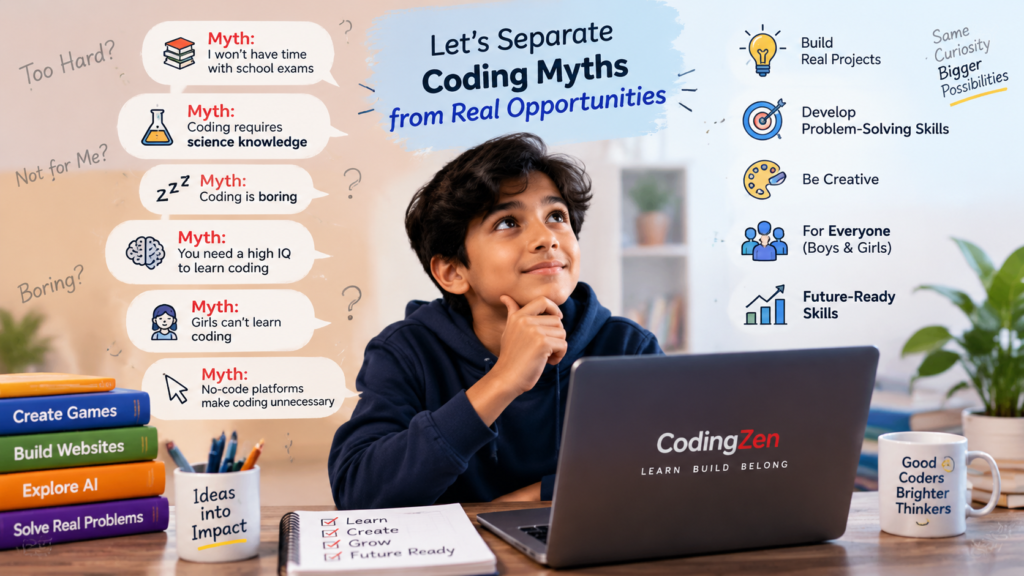
Do you listen to myths surrounding coding regularly? Don’t worry-these are myths for a reason. In this blog, we’re going to talk about the most common myths people hear, and the truth that is present besides these myths.
Myth: Coding disturbs kids’ study routine
A kid has to prepare for many examinations during school. In addition, kids need to prepare for multiple assessments, whether it’s mid-term assessments, final-term assessments, or homework. Hence, parents often worry about whether their kids will have adequate time to devote to their school curriculum if they decide to learn coding.
Truth: While it’s true that children need to prepare for examinations that are a part of their study in school, coding helps them learn beyond theory. School examinations do not provide enough opportunities for students to put their theoretical knowledge into practice. Hence, coding knowledge is necessary so kids can create projects in fields like game development, website development, and so on. Moreover, learning coding classes for kids and the school curriculum teaches kids the time management skills they need to succeed.
Myth: Coding requires knowledge of science
One common misconception both kids and parents have in mind is that coding requires knowledge of science.
Truth: No matter what you study in school, you can always study coding through YouTube videos, online learning academies, and other learning resources. The knowledge of coding is not just crucial for programmers but also kids interested in fields like business analytics and market research.
Myth: Coding is a monotonous activity
It’s easy to visualise a coder as someone who fits in front of a computer all day long, not focusing on any other task. After all, coding requires significant concentration to execute the codes in the desired manner.
Truth: While coding can seem a monotonous activity, it requires a high level of creativity. Whether it’s a shooting game or a game similar to Candy Crush, coding requires kids to visualise plots, characters, and animations during the game development process. Similarly, a child has to look at aspects like the website background, the layout, and how to present images and videos on website pages.
Myth: You need a high IQ to learn coding
A big myth in people’s minds is that they must have a very high level of intelligence to learn coding. As a result, many kids believe that coding isn’t for them, and they easily get demotivated to code.
Truth: One’s intelligence quotient does not have a high level of correlation to coding. Anyone can learn coding if they receive the support of the right mentor.
Myth: Female kids struggle to learn coding
Coding is often viewed as an activity that is only for male kids. Male students create and highlight many projects; sometimes, female students do not get the limelight they deserve.
Truth: Female kids can learn coding easily with the right mentors and methods. The notion that male kids are somewhat ‘’better’’ than female kids needs to be broken.
Myth: Coding is not necessary because of no-code platforms
In the current era, multiple ‘no-code’ platforms have emerged. These platforms or software help one create websites or build mobile applications with no knowledge of coding. Hence, many parents and kids believe that coding classes for kids are not required.
Truth: Despite the popularity of no-code platforms/software, one cannot rule out the importance of learning coding. No-code platforms are not as scalable as platforms where code is written and executed by a developer. In addition, no-code platforms are rigid, meaning that some functionalities may not be available if one chooses to use them. They may not help obtain the result desired after typing the code to execute a game, website, or any other project.
Learning to code is an investment that will repay kids throughout their lives. Do you want to learn how you can determine the best coding program that will help your child enhance their skill set? Then, you can check out this blog-”How to discover the best coding program for your kids’’.