How Coding Helps Improve Planning and Organisation Skills of Children?

Posted on March 12, 2021August 30, 2022

According to the Bureau of Labor Statistics, in 2020, Computer and Information Systems Managers were the highest-paid coding professionals with a record median salary of $151,150. These Managers are considered veterans, when it comes to the soft skills of planning and organisation. 

The pandemic is hopefully over and now the kids are back in their classes. Yet, it has been observed around the globe that the long pandemic has devolved the soft skills of these children, especially when it comes to planning and organisation. Their attention span has receded, they show little interest in classroom activities, and most important of all, they are unable to plan out and organise tasks assigned to them in the class. 

Luckily, here, at Codingzen, we have a one-shot panacea for your adolescents and pre-adolescents. Our programs teach the very-valuable talent of ‘coding’, which top companies in the market are often in the hunt of, irrespective of whether they are in the software development sector. 

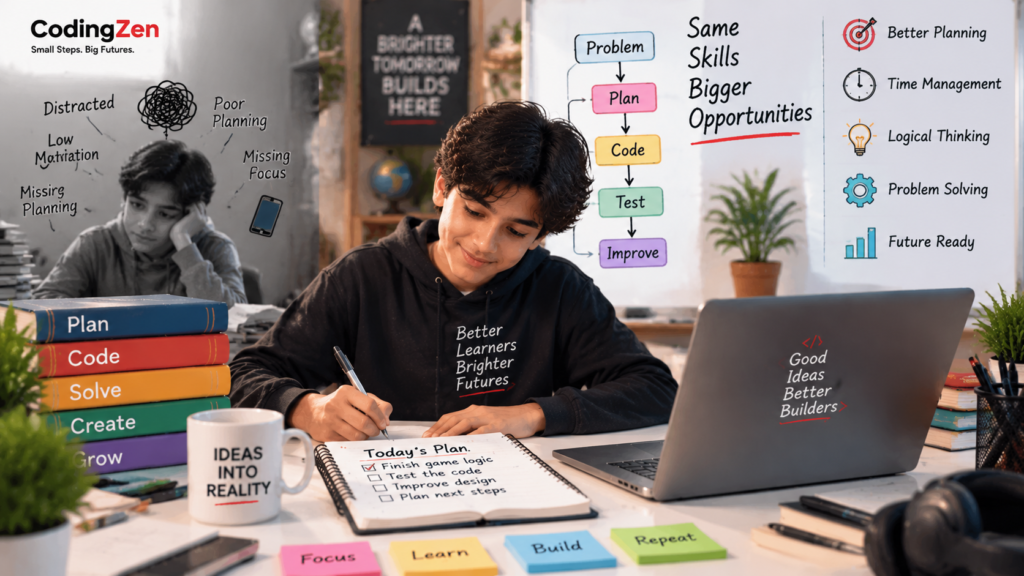
By learning to code, a child is taught how to arrange tasks in a logical order. They learn how to divide their time efficiently to complete their work as soon as possible. They also are taught how to establish priorities in a systematic way, differentiating between urgent, very urgent, and unimportant assignments.

To illustrate how coding helps improve planning and organisation skills of children, here are some practical points:

  • Through coding, children learn how to create a procedure or an algorithm to solve a problem. For example, consider a Scratch program where conditional coding (if-then-else) has been used. By using conditional coding repetitively and in a number of instances, children subliminally learn the importance of planning for worst-case and best-case scenarios in the future.     
  • Programming in object-oriented languages allows a coder to use modularity. Modularity in turn teaches a young one how to encapsulate objects or code that are like each other. For example, if a kid learns to create and group objects “Add”, “Subtract”, “Multiply”, and “Divide” in the class “Calculator” for a Calculator program, they’ll eventually understand the importance of grouping similar real-life tasks easily. They’ll get to know that grouping sub-tasks makes an entire task swifter to complete. 
  • By learning the concept of data abstraction, children will be taught how to hide certain information from selected individuals in their daily life. In the concept of data abstraction, in Java, the young coders will learn how to use access modifiers like ‘Protected’ and ‘Private’, which hide data points from the accessible ‘Public’ parts of the program.    
  • When coding, kids can create a function where one can enter different data types (like character, integer, float) and receive different results with respect to the data type entered. This coding device is called ‘polymorphism’ and it teaches the organisation skill of creating different versions of the same thing, then using it according to the needs at that time. 

An individual who wants to create his own software company or venture into the waters of serial entrepreneurship needs advanced planning and organisational skills. Even in a corporate environment or a professional setting, employers look for candidates who can handle their work through efficient planning and organise their future teams in such a way that there are no exceptions raised by clients. 

It’s better to start early with children as they learn faster than adults. Their prefrontal cortex that is still under development makes learning organisation skills easier, as they are able to tabulate and prioritise tasks under different labels. Therefore, coding classes are the best gift you can give your children if you want to create for them a bright future, rich with entrepreneurial journeys and frequent applications of creative ideas. 
image
image

Similar Posts

HTML, CSS and JavaScript for Kids: How Children Can Learn to Build Their Own Websites

Your child probably visits dozens of websites every week. But have they ever wondered what makes a website work? Why does a button change colour when someone clicks it? How does a website arrange pictures and text? What makes an online quiz respond when an answer is selected? Behind these everyday experiences are technologies that children can learn to understand and use themselves. HTML, CSS and JavaScript for kids offer a practical introduction to website development. Instead of simply exploring websites created by others, children can discover how to design pages, organise information and add interactive features. For parents considering web development for kids, understanding what these three technologies do is a useful starting point. What Are HTML, CSS and JavaScript? HTML, CSS and JavaScript are three foundational technologies used in building websites. Although they work together, each has a different responsibility. Consider a website for a school science exhibition. HTML: Creating the Website’s Structure HTML stands for HyperText Markup Language. It tells a web browser what information belongs on a page and how that content is organised. A student could use HTML to add: HTML gives the page its structure, much like arranging chapters, headings and photographs in a book. CSS: Making the Website Look Appealing CSS stands for Cascading Style Sheets. Once the content is organised, CSS controls its visual presentation. A child could use CSS to give the exhibition website a green background, adjust the spacing between photographs or create different styles for headings. CSS also helps developers create layouts that adapt to different screen sizes. This introduces an important idea: designing something digitally involves thinking about how people will experience it. JavaScript: Making the Website Interactive JavaScript is a programming language that adds interactive behaviour to websites. Imagine the science exhibition website includes a button labelled “Reveal the Answer.” With JavaScript, a student can make that button display the answer to a question when clicked. Children can gradually explore more complex interactions, including quizzes, image galleries and forms. Together, HTML provides structure, CSS handles presentation and JavaScript adds interactive functionality. 

Data Science for Kids: How Children Can Learn to Understand the World Through Data

Your child checks the weather forecast before deciding whether to carry an umbrella. Later, they compare the scores of their favourite cricket players or notice which YouTube videos receive more views. These everyday situations have something in common: data. Children regularly encounter numbers, patterns and comparisons. What they may not realise is that this information can be collected, organised and examined to answer interesting questions. That is where data science for kids becomes valuable. Data science introduces children to the process of asking questions, working with information, identifying patterns and drawing reasonable conclusions. It is not simply about learning complicated mathematical formulas. For beginners, it can start with something as familiar as tracking daily temperatures or comparing how plants grow under different conditions. What Is Data Science for Kids? Data science is the process of using information to investigate questions and make informed decisions. For children, it involves learning how to collect, organise, analyse and interpret data in an understandable way. Consider a simple question: “Which day of the week do I spend the most time reading?” A child could record their reading time over seven days, arrange the information in a table and create a bar chart. After examining the chart, they might discover that they read longer on weekends. This activity introduces several fundamental data science concepts without requiring advanced technology. It teaches children that information becomes more useful when they learn how to examine it carefully. Why Is Data Literacy Important for Children? Children increasingly encounter information through websites, educational applications, social media and digital devices. Understanding how to interpret that information is an important part of digital literacy. Data literacy is the ability to read, question, understand and communicate information presented through data. Learning to Ask Better Questions Suppose a child sees a chart showing that one sport is more popular than another. Instead of accepting the result immediately, they can learn to ask: These questions encourage thoughtful interpretation rather than unquestioning acceptance. Understanding Patterns and Trends Data analysis helps students explore how information changes.

logo think create apply new 2 2048x525 1
Group 271
Group 545 4
Group 270

Launching New
3D Unity Course