How to discover the best coding program for your kids

Posted on March 12, 2021June 15, 2022

When we talk about learning the foundational skills of this era, coding programs for kids are considered the most important ones. This is because it helps the kids get ready for the future by opening up career opportunities. Additionally, coding courses for kids help them understand what goes behind developing websites, games, and mobile applications.

Kids are inquisitive to learn new concepts at a young age. Kids’ parents can help their curious kids take the first step toward learning to code. Many of them mostly plan to start with the newest programming languages, though good coding skills never become emaciated. When choosing the best coding programs for kids, it is crucial to be extremely careful with the choice. This is because the right program will help unlock opportunities for your kid in the future. 

We’ve mentioned 4 coding programs kids can learn in this blog:

Game Development: The game development process includes the designing, development, testing, and release of the game. While creating a new game, it is vital to keep in mind a few points, such as player engagement, rewards, and mechanics, together with designing various game levels. By learning game development, the kids will be able to comprehend the things behind the games they play as they will make efforts to define the characters, set the game plot, and determine the game background. Kids can learn game development with Unity Game Engine, a cross-platform engine that helps build 2D and 3D multiplatform games and other interactive experiences.

Android App Development: Android app development is the process through which a variety of apps are created for the devices working with the support of the Android operating system. Android is an open-source project (the users can edit the product’s source code). Hence, developers have easy access to the Android software development kit. (SDK) The MIT App Inventor is a web-based application building tool.

Android App Development

Web Development: Web development is creating a website for the Internet. Web development is easy to learn and a fun experience. The benefit of learning web development for kids is that they will get an opportunity to show their creativity on the Internet. In addition, students can learn the basics of HTML, CSS, Bootstrap, and JavaScript to build aesthetic, functional websites.

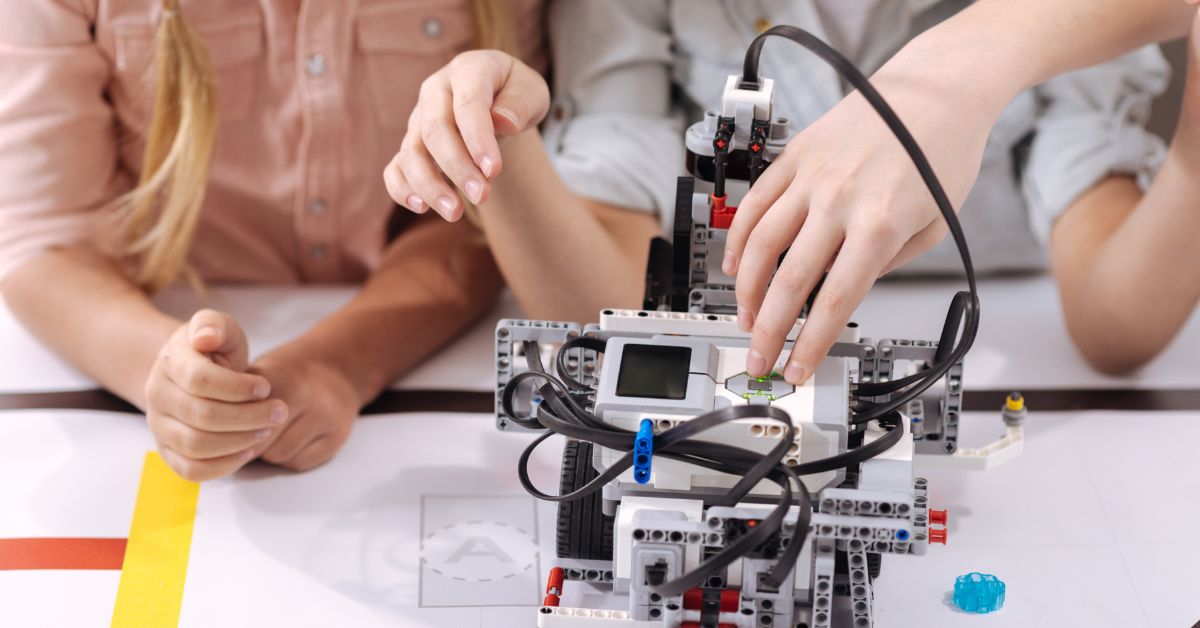
Robotics: It is the process of programming the microcontroller inside a robot to perform a specific task. The significant advantage for kids in learning robotics is that they will get encouraged to show interest in science, technology, engineering, and mathematics. In addition, they will develop problem-solving skills by resolving errors and hurdles that come up during this kind of programming.   

Robotics

All the options mentioned above for coding programs are brilliant for kids to start early (5+ years). This small step will help children kickstart their coding journey.

Choosing coding programs for kids

The learning power of kids at a younger age is faster than adults. It is mainly due to the brain’s prefrontal cortex, which is more developed in adults than kids. Hence, adults have functional fixedness, and kids do not, helping kids perceive things differently than adults (not in a  very fixed manner). Therefore, this is the ideal time for introducing kids to different coding courses.

Here are some factors that can help you discover the right coding programs for kids:

  • Look for your kid’s interest

Before choosing a coding program for your kids, it is essential to know the kid’s interest area. Then, it will make it easy for you to select a coding program that will interest them. For example, if a kid plays games all day long, they may be interested in learning game development. Likewise, if your child wonders how websites are made, they may be interested in website development.

  • Look into the course details

Before getting the child enrolled in a program, it is necessary to know what will be taught in the entire program. It will make it easy for you to choose the right coding program. Check for the study structure followed in the course and learning methods involved, such as quizzes, skill assessments, test sessions, etc. These are important because the kids will learn better through the regular practice followed during the program.

  • Faculty Knowledge

Before getting your child enrolled in a coding program, it is necessary to check for the faculty knowledge and qualification, as they will be making your child learn a new skill. Make sure that the faculty teaching your kids is experienced enough to make them learn in the best way possible. 

Summing it up..Coding classes will help the kids get ready for the future by making them think analytically, boost their problem-solving skills, and promote learning by doing. If you want your child to be a coding champ of the future, wisely choose the best coding programs for kids. Are you wondering about the right age to enrol your kids in a coding program? Click here to know.

Similar Posts

Game Physics for Kids: How Do Video Games Make Movement Feel Real?

A character jumps across a platform, lands on the ground, and continues running. It looks effortless. But behind that simple movement, a game is performing calculations that determine how high the character jumps, how quickly it falls, and exactly when its feet touch the platform. These movements are not accidental. They are created through programming and mathematical rules. Understanding game physics for kids introduces an interesting connection between gaming, coding, and real-world science. For children who enjoy playing video games, discovering how movement works behind the screen can make game development an engaging learning experience. Instead of simply controlling a character, students begin understanding the rules that make the character respond. What Is Game Physics for Kids? Game physics refers to the mathematical rules and programming systems that simulate movement and physical interactions inside video games. In real life, objects respond to forces such as gravity and friction. Video games recreate selected aspects of these behaviours using calculations. For example, a game might need to determine: These behaviours are controlled through programming. However, game physics does not always need to imitate reality perfectly. A superhero might jump unusually high. A racing car might turn more sharply than a real vehicle. Developers adjust physical rules to create the experience they want players to have. How Does Gravity Work in Video Games? Gravity is one of the most recognisable concepts in game physics. When a character jumps, it initially moves upward, slows down, and eventually begins falling. In many games, this effect is created by changing the character’s vertical velocity over time. Velocity describes how quickly an object moves and in which direction. Gravity changes that velocity, causing the character to accelerate downward. A Simple Example of Coding Gravity Imagine a game character standing on a platform. When the player presses the jump button, the program gives the character an upward velocity.

Pseudocode for Kids: Why Learning to Plan Before Coding Makes a Difference

Your child sits down to build a simple program. They know what they want it to do, but after writing a few lines of code, they get stuck. The problem might not be the programming language. It could be that they haven’t decided exactly how the program should work. This is where pseudocode for kids becomes a useful learning tool. Pseudocode helps students organise their ideas into clear instructions before translating them into actual programming code. Instead of immediately worrying about brackets, spelling or syntax, children can focus on the logic behind their solution. For parents exploring coding education, understanding pseudocode offers a useful perspective on what happens before a successful program is written. What Is Pseudocode in Coding? Pseudocode is a simplified way of describing the steps a computer program should follow. It uses ordinary language combined with basic programming concepts such as conditions, repetition and instructions. Unlike Python, JavaScript or other programming languages, pseudocode cannot be executed directly by a computer. Its purpose is to describe the logic of a solution clearly enough that someone can later convert it into working code. For example, imagine a program that checks whether a student has completed their homework. The pseudocode could look like this: This example introduces a conditional statement without requiring the child to memorise the syntax of a particular programming language. Educational resources from Oak National Academy also describe pseudocode as a language-independent way of representing algorithms.  Oak National Academy Why Should Children Learn Pseudocode Before Writing Code? Writing instructions before coding encourages children to separate two different challenges: deciding what a program should do and learning how to express those instructions in a programming language. 1. It Helps Children Organise Their Thinking A programming idea may seem simple until a student tries to explain every step. Consider a program that recommends an activity depending on the weather. The child needs to decide what information the program receives, what conditions it checks and how it selects an answer. Pseudocode provides a structure for arranging these decisions logically. 2. It Makes Programming Logic Easier to Examine Imagine a child designing a program that checks whether someone qualifies for a library membership. Before writing code, they need to decide what happens when the user meets the requirements and what happens when they do not.

logo think create apply new 2 2048x525 1
Group 271
Group 545 4
Group 270

Launching New
3D Unity Course