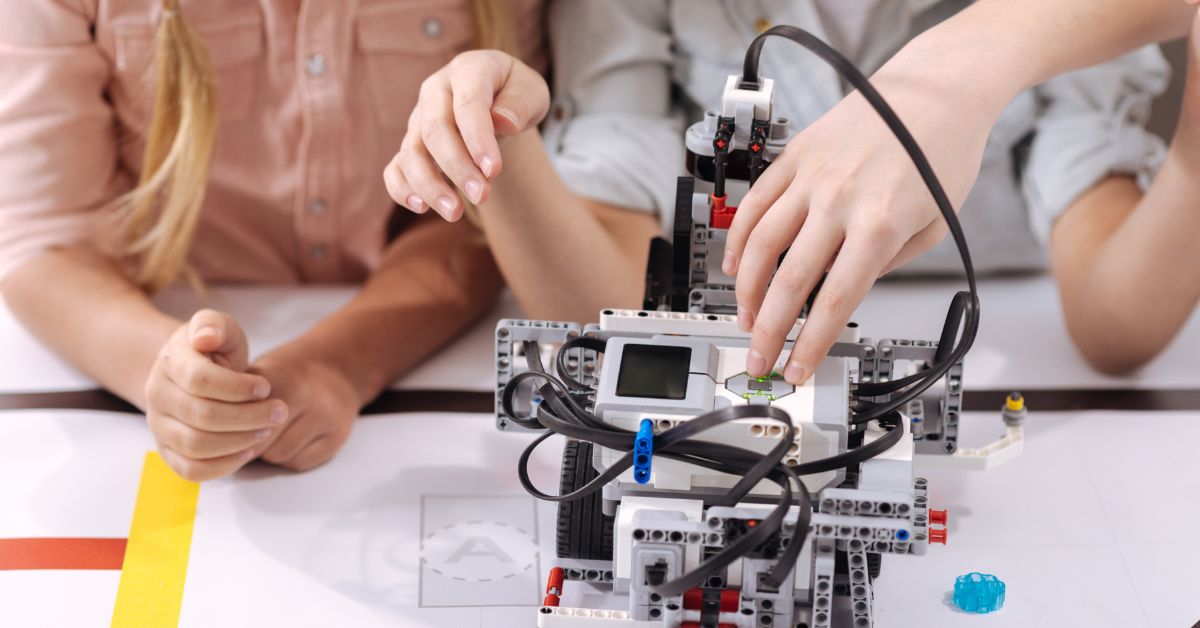
Coding as a skill helps children learn how to create websites or mobile applications, develop software, and create new games. It enhances a kids’ concentration level and allows them to view the creative ideas they have in mind, like games, come to life. In addition, teaching your kids to code can prepare them for future professional options like business analysts and software engineers and teach them skills like problem-solving, critical thinking, digital literacy, and logical thinking.
Let’s go over some of the reasons to know why learning to code is essential for kids:
1. Coding Offers Kids A Global Perspective
Students can obtain a better knowledge of how things work by comprehending computers and learning coding principles. In addition, they connect with other programmers to learn how software programmers utilize math to solve issues in a logical and inventive manner. They learn to identify a considerable problem and break it down into smaller pieces and understand how different issues, like community-related social issues can be solved through the knowledge of coding. For example, a mobile application connects the elderly to youngsters for social service.
2. Coding Teaches entrepreneurship skills
You should teach your kids to code as it teaches them to recover from setbacks. They learn that failure isn’t always a negative thing, and in fact, it may frequently be beneficial because it provides an opportunity to learn. It is one of the most critical personality traits of an entrepreneur. One of the most compelling reasons children learn to code is that they will rapidly discover that ‘debugging’ their code is one of the most satisfying goals to achieve as a programmer. Coding enables children to attempt and try again until they reach the desired outcome and take risks.

3. Coding Teaches Creativity
Creating things linked to what kids enjoy provides them with a natural source of inspiration. For example, when children learn to code, they are encouraged to use their imagination and improvise when their skills are restricted based on their prior knowledge of coding. Coding also provides children a sense of accomplishment and boosts their self-confidence when they can design something that works.
4. Coding prepares students for the mindset shift from ‘technology consumers’ to ‘technology creators’
Kids are exposed to technology from a young age in the modern era. Coding helps shift their mindset from technology consumers to technology creators. The kids who know how to code are better at thinking critically. Coding isn’t confined to typing long lines of programming, it is about teaching children new ways to think. It is required for a programmer to be able to think logically to create code efficiently. There isn’t one fixed program for coding a solution, and there could be multiple different ways to write the same code.
5. Coding teaches computational thinking
Children develop cognitive skills and learn a logical, problem-solving approach similar to a computer as they learn to read and write code. They know how to use abstractions and recognise patterns to represent the problem in new and different ways and logically organize or analyze data.

Running the procedures, analyzing the results, and determining whether the results yielded an acceptable answer are all parts of the learning process. Students can apply computational thinking to situations other than coding because it is a way of thinking that solves practical problems.
6. The future of computer programming is bright
When you consider how the world is becoming technologically advanced, coding is a useful skill. Computer code is used in many organisations, not simply those in the technology sector, but in sectors like education, healthcare, and finance. Did you know that the Indian coding and marking systems market is expected to grow to $127.6 million by 2030? (Source: RESEARCHANDMARKETS)
Children who learn how to code will always have an advantage in terms of more job prospects available in the future regardless of the industry and the field where they choose to work. Job opportunities include data scientist, data analyst, and database administrator.
7. Enhances Self-Assuredness and Communication
It’s time to break the myth: coding is not a solo endeavor. Most software engineers work in groups to meet development goals except freelancers and one-person organizations.
Coding is a wonderful skill that provides opportunities for collaboration. Coding in a group can help them develop teamwork and communication skills, which can help them navigate social situations, collaborate with others, perform well academically, and achieve their goals.
Above all, children learn to establish confidence and a positive self-image. A coding project teaches your youngster that they can solve any problem with perseverance and teamwork.
By reading this blog, we hope you’ve obtained a better understanding regarding why learning to code is vital for kids. Are you unsure about the age when you should teach your kids to code? Check out this article to know the appropriate age for a kid to start coding.