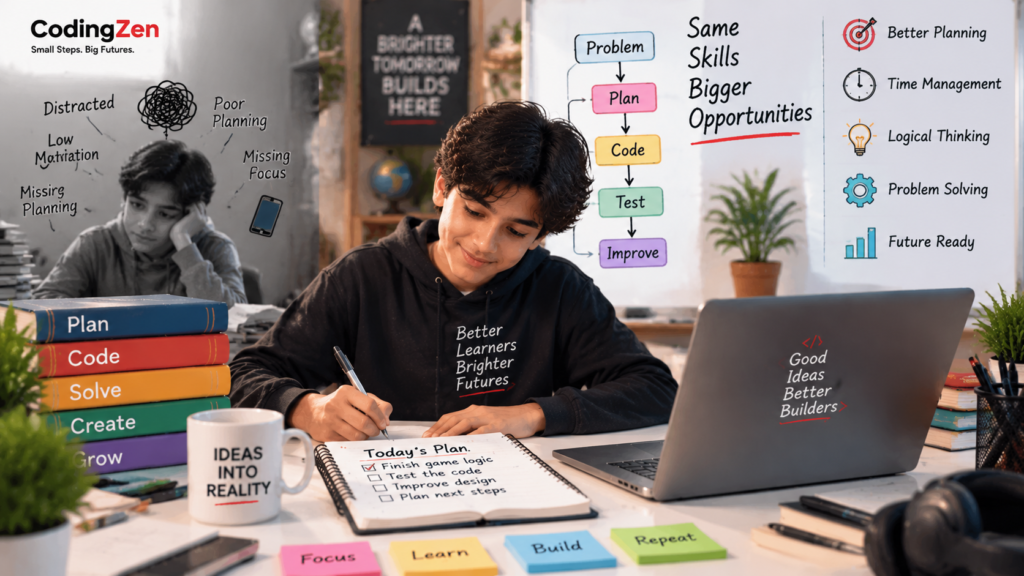
According to the Bureau of Labor Statistics, in 2020, Computer and Information Systems Managers were the highest-paid coding professionals with a record median salary of $151,150. These Managers are considered veterans, when it comes to the soft skills of planning and organisation.
The pandemic is hopefully over and now the kids are back in their classes. Yet, it has been observed around the globe that the long pandemic has devolved the soft skills of these children, especially when it comes to planning and organisation. Their attention span has receded, they show little interest in classroom activities, and most important of all, they are unable to plan out and organise tasks assigned to them in the class.
Luckily, here, at Codingzen, we have a one-shot panacea for your adolescents and pre-adolescents. Our programs teach the very-valuable talent of ‘coding’, which top companies in the market are often in the hunt of, irrespective of whether they are in the software development sector.
By learning to code, a child is taught how to arrange tasks in a logical order. They learn how to divide their time efficiently to complete their work as soon as possible. They also are taught how to establish priorities in a systematic way, differentiating between urgent, very urgent, and unimportant assignments.
To illustrate how coding helps improve planning and organisation skills of children, here are some practical points:
- Through coding, children learn how to create a procedure or an algorithm to solve a problem. For example, consider a Scratch program where conditional coding (if-then-else) has been used. By using conditional coding repetitively and in a number of instances, children subliminally learn the importance of planning for worst-case and best-case scenarios in the future.
- Programming in object-oriented languages allows a coder to use modularity. Modularity in turn teaches a young one how to encapsulate objects or code that are like each other. For example, if a kid learns to create and group objects “Add”, “Subtract”, “Multiply”, and “Divide” in the class “Calculator” for a Calculator program, they’ll eventually understand the importance of grouping similar real-life tasks easily. They’ll get to know that grouping sub-tasks makes an entire task swifter to complete.
- By learning the concept of data abstraction, children will be taught how to hide certain information from selected individuals in their daily life. In the concept of data abstraction, in Java, the young coders will learn how to use access modifiers like ‘Protected’ and ‘Private’, which hide data points from the accessible ‘Public’ parts of the program.
- When coding, kids can create a function where one can enter different data types (like character, integer, float) and receive different results with respect to the data type entered. This coding device is called ‘polymorphism’ and it teaches the organisation skill of creating different versions of the same thing, then using it according to the needs at that time.
An individual who wants to create his own software company or venture into the waters of serial entrepreneurship needs advanced planning and organisational skills. Even in a corporate environment or a professional setting, employers look for candidates who can handle their work through efficient planning and organise their future teams in such a way that there are no exceptions raised by clients.
It’s better to start early with children as they learn faster than adults. Their prefrontal cortex that is still under development makes learning organisation skills easier, as they are able to tabulate and prioritise tasks under different labels. Therefore, coding classes are the best gift you can give your children if you want to create for them a bright future, rich with entrepreneurial journeys and frequent applications of creative ideas.