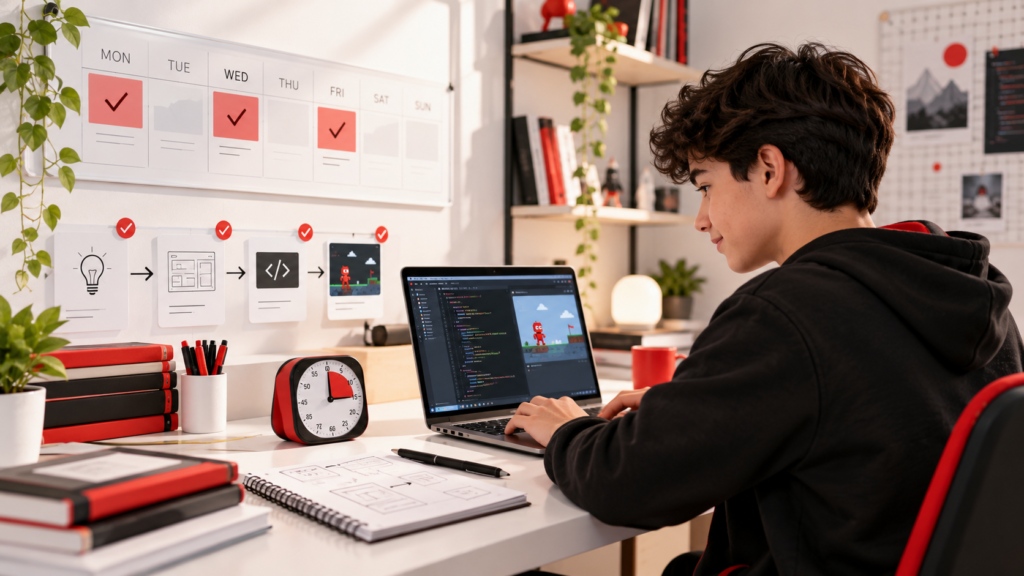
A parent signs their child up for coding classes, the child enjoys the first few sessions, and then an important question appears:
How often should they actually practise?
Some parents assume that more practice automatically means faster progress. Others worry that adding coding practice to schoolwork, sports, and other activities will create unnecessary pressure.
The useful answer sits somewhere in between.
When deciding how often kids should practice coding, consistency matters more than forcing long hours. A child who returns to coding regularly, works on small problems, and builds projects over time is usually creating a healthier learning habit than someone who codes intensely once every few weeks.
The right routine depends on age, experience, attention span, and what the child is currently learning.
How Often Should Kids Practice Coding?
For most children, coding does not need to become a daily obligation.
A beginner can benefit from two to three meaningful coding sessions each week, including structured classes and independent practice. Older students working on larger projects may naturally spend more time.
The important word is meaningful.
Thirty focused minutes spent fixing a game mechanic, practising loops, or improving a small project can be more useful than sitting in front of code for two hours without a clear goal.
Coding practice should help students remember concepts, experiment with ideas, and become more independent. It should not simply increase screen time.
Why Regular Coding Practice Matters
Programming involves ideas that become easier to use when students encounter them repeatedly.
A child may understand a loop during a lesson but struggle to remember how to use one a week later.
That does not necessarily mean they failed to learn it.
They may simply need more opportunities to apply the concept.
Regular practice gives students repeated contact with:
variables
conditions
loops
functions
debugging
logical sequences
project structure
The goal is not memorisation for its own sake. It is familiarity.
When concepts become familiar, students can spend less mental effort remembering syntax and more effort deciding how to solve problems.
Short, Frequent Sessions Can Be Better Than Long Coding Marathons
Children often learn better when they can return to a concept several times instead of attempting to absorb everything in one sitting.
Imagine two students.
The first codes for three hours on Sunday and does nothing for the rest of the week.
The second spends 30 to 45 minutes coding on Tuesday, Thursday, and Saturday.
Both may spend a similar amount of total time, but the second student has more opportunities to revisit concepts, remember previous decisions, and build continuity.
Shorter sessions can also make practice feel less intimidating.
A child is more likely to begin if the goal is:
“Let’s fix one part of the game.”
rather than:
“You need to practise coding for two hours.”
Coding Practice Should Change With Age
A five-year-old and a fifteen-year-old should not have the same coding routine.
Younger Children
For younger learners, sessions should usually be shorter and more interactive.
They may work with visual programming environments, simple logic activities, games, or guided projects.
The goal at this stage is to build curiosity and familiarity with sequences, cause and effect, and basic computational thinking.
Forcing long independent practice sessions can quickly remove the enjoyment.
Middle School Learners
Children in the middle-school years may be ready for more structured practice.
They can begin revisiting concepts from class, modifying existing projects, solving small programming challenges, or learning text-based coding such as Python.
At this stage, practice can gradually shift from guided exercises toward more independent creation.
Teenagers
Teenagers may be able to work for longer periods, especially when they are developing websites, Python applications, games, AI projects, or other larger builds.
However, longer sessions are not automatically better.
A focused project with clear milestones still works better than open-ended screen time.
What Should Kids Actually Do During Coding Practice?
One reason children lose interest in coding practice is that practice becomes repetitive.
Typing similar exercises again and again can feel disconnected from why they wanted to learn coding in the first place.
A stronger routine mixes several types of activity.
Rebuild Something From Memory
After learning a concept, students can try recreating a simple version without following the original instructions.
This quickly reveals what they genuinely remember.
For example, after learning loops, a child might recreate a repeating animation or number pattern.
Modify an Existing Project
Students do not always need to begin from a blank screen.
They can take an existing project and change one feature.
A simple game might receive a new scoring system.
A website might get another page.
A Python program might be modified to handle additional user input.
Changing projects encourages students to think about how existing code works.
Debug Something
Debugging is valuable coding practice because it requires students to inspect their assumptions.
Rather than only writing new code, they learn to ask:
What did I expect?
What actually happened?
Where might the logic be breaking?
This kind of investigation is an important part of becoming more independent.
Build Something Personal
Children often practise longer when the project connects with something they care about.
A student interested in football might create a score tracker.
Someone who enjoys storytelling might design an interactive story.
A child interested in games might build a simple level or character mechanic.
Personal relevance can turn practice from an assignment into experimentation.
Parents Do Not Need to Become Coding Teachers
Parents sometimes hesitate to support coding practice because they do not know Python, JavaScript, robotics, or AI.
That is completely workable.
Parents can support learning without solving technical problems.
Ask questions such as:
“What are you trying to make?”
“What part is working?”
“What are you stuck on?”
“What did you change?”
“What will you try next?”
These questions encourage children to explain their reasoning.
Parents can also help by protecting a small amount of regular practice time and avoiding the temptation to turn every session into a performance test.
The objective is gradual progress, not constant assessment.
How Structured Classes and Practice Work Together
A coding class provides instruction, feedback, and progression.
Practice gives students the chance to make those ideas their own.
The two work best together.
A student might learn functions during a structured session and then spend a short practice period using functions in a small personal project.
That connection helps move learning beyond simply completing lessons.
At CodingZen, project-based learning is designed around the idea that students should not only hear about programming concepts but also use them to build, test, and improve something.
A useful coding routine therefore includes both guided learning and opportunities to experiment independently.
Signs That a Coding Routine Is Working
Parents do not need to track every line of code.
Instead, look for gradual changes in how the child approaches problems.
Positive signs may include:
starting projects with less hesitation
remembering previously learned concepts
asking more specific questions
trying several solutions before requesting help
explaining how a project works
returning to unfinished ideas
making independent changes to existing projects
These behaviours often say more about learning than simply counting practice hours.
What If a Child Does Not Want to Practise?
Not every skipped practice session is a problem.
Children can become tired, busy, or temporarily less interested.
Before increasing pressure, it is worth asking why practice has become difficult.
Maybe the current project feels too hard.
Maybe exercises are repetitive.
Maybe the child does not understand the purpose of what they are learning.
Maybe their schedule is already full.
Sometimes the solution is not more discipline. It is changing the type of practice.
A smaller project, a new challenge, or more creative freedom may restore interest.
Consistency Should Not Become Pressure
There is an important difference between creating a routine and turning coding into another source of stress.
A useful schedule should fit alongside school, rest, sport, reading, family time, and other interests.
Coding is one area of learning, not a measure of a child’s productivity.
For many students, sustainable progress comes from returning regularly rather than practising constantly.
That is why parents should focus less on hitting an exact number of hours and more on whether the child is continuing to build, experiment, and understand.
Conclusion
So, how often should kids practice coding?
There is no universal number that fits every learner.
For many children, two to three focused sessions per week can provide enough repetition to reinforce learning without making coding feel overwhelming. Younger students may need shorter sessions, while teenagers working on larger projects may naturally spend more time.
The key is consistency.
A good coding routine helps children revisit ideas, test what they understand, make mistakes, debug problems, and build projects that gradually become more independent.
CodingZen supports this kind of structured progression through practical, project-based learning designed to help students move from understanding concepts to using them confidently.
CTA
Looking for a structured way to help your child build consistent coding skills? Explore CodingZen’s online coding learning options across programming, Python, AI, robotics, game development, and other technology areas.
FAQs
How many days a week should a child practise coding?
For many learners, two to three focused sessions per week can be a practical starting point. The ideal frequency depends on the child’s age, experience, and schedule.
How long should a coding practice session be?
Younger children may benefit from shorter sessions, while older students can often work for longer periods. Focus and engagement matter more than hitting a fixed duration.
Should kids practise coding every day?
Daily practice is not necessary for every child. Regular, sustainable practice is usually more important than forcing coding into every day.
What is the best way for beginners to practise coding?
Beginners can revisit concepts from class, modify simple projects, solve small challenges, debug errors, and rebuild basic programs from memory.
How can parents support coding practice without knowing programming?
Parents can provide regular practice time, ask children to explain what they are building, encourage experimentation, and help them reflect on what they tried when something did not work.