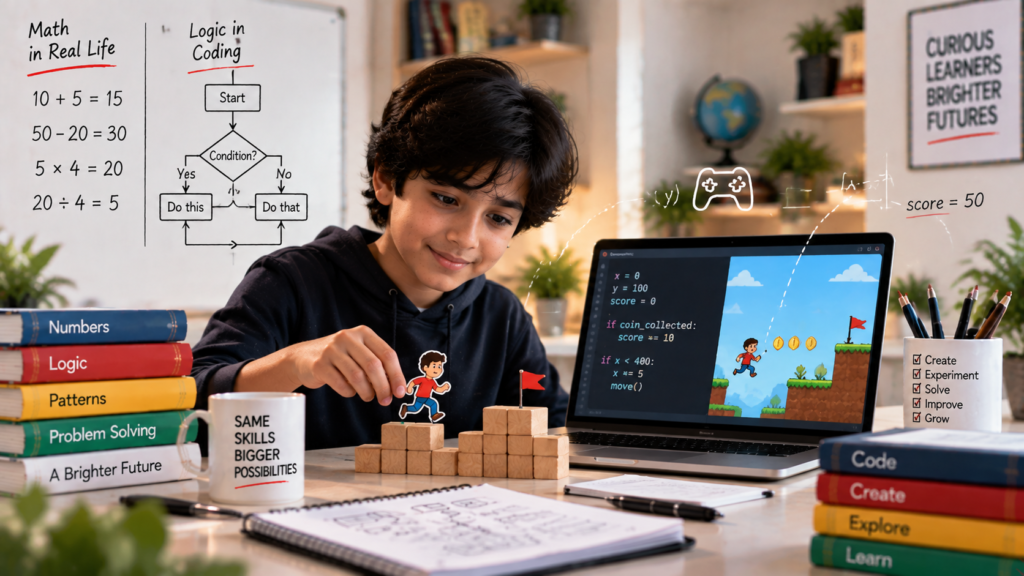
For many children, maths can sometimes feel like a collection of formulas, calculations and rules that need to be memorised.
Coding approaches the same kind of thinking differently.
Instead of simply solving a problem on paper, children use numbers, patterns and logic to make something happen. They might calculate how far a game character should move, decide how many points a player earns, position an object on a screen or create rules that determine what happens next.
This is one reason coding and math skills for kids can complement each other so naturally.
Coding does not replace mathematics lessons. Instead, it gives children another environment where mathematical thinking can become practical, visual and interactive.
Why Are Coding and Mathematics Connected?
Both coding and mathematics involve understanding a problem and breaking it into manageable steps.
Imagine a child creating a simple game.
They may need to decide:
• How fast should the character move?
• How many points should each action earn?
• What happens when the score reaches 50?
• Where should an object appear on the screen?
• How long should something remain visible?
Suddenly, numbers are not simply questions in a textbook.
They are helping the child build something.
This practical application can help children understand why mathematical concepts matter.
1. Coding Encourages Logical Thinking
Logical thinking is one of the most important connections between coding and maths for children.
Programs operate according to instructions and conditions.
For example:
“If the player touches the object, add 10 points.”
“If the answer is correct, move to the next question.”
“If the timer reaches zero, end the game.”
Children start recognising that one action can lead to another depending on a specific condition.
This helps them practise structured thinking.
Instead of randomly trying different solutions, they begin asking:
“What needs to happen first?”
“What condition needs to be true?”
“What should happen next?”
That same thinking is useful when solving mathematical problems.
2. Coding Makes Patterns Easier to Understand
Patterns appear everywhere in programming.
A child might notice that the same instruction needs to happen several times.
Instead of writing it repeatedly, they may learn to use a loop.
For example, imagine a character that needs to take ten steps.
Rather than writing the movement instruction ten separate times, the child can tell the program to repeat the instruction.
This introduces an important idea:
Identify the pattern, then find a more efficient solution.
Pattern recognition is also an important mathematical skill.
Children regularly encounter sequences, multiplication patterns, shapes, number relationships and repeated operations in maths.
Coding gives them another opportunity to recognise and work with those patterns.
3. Children Use Coordinates Without Realising It
When children create animations, games or visual projects, they often need to position objects on a screen.
That introduces them to coordinates.
An object might need to move:
• left or right,
• up or down,
• to a particular point,
• or by a specific distance.
Instead of learning coordinates only as an abstract concept, children can see the result immediately.
Change a coordinate and the object moves.
Change the direction and the character behaves differently.
This connection between an instruction and a visible outcome can make concepts such as position, direction and measurement much easier to understand.
4. Coding Develops Problem-Solving Skills
One of the most useful skills children develop while learning coding is the ability to approach a problem systematically.
Programs rarely work perfectly on the first attempt.
A child might expect a character to jump but discover that it moves backwards.
A score might increase twice instead of once.
An animation might stop too early.
Now the child has a problem to investigate.
They need to ask:
What was supposed to happen?
What actually happened?
Which instruction caused the difference?
What can I change?
This process is known as debugging.
It is also very similar to checking a mathematical solution.
Instead of immediately assuming that they “cannot do it,” children can learn to inspect their process and locate the mistake.
That shift in thinking is valuable far beyond coding.
5. Coding Shows Children That There Can Be Different Solutions
School problems sometimes appear to have one correct method.
Coding introduces children to another useful idea:
There may be several ways to solve the same problem.
Two students can build the same basic game using different instructions.
Both programs may work.
However, one might use fewer steps, be easier to understand or be easier to modify later.
This encourages children to think beyond simply asking:
“Is my answer correct?”
They can also ask:
“Is there another way to solve this?”
“Can I make this simpler?”
“Can I improve my solution?”
That kind of thinking helps children become more flexible problem-solvers.
6. Coding Gives Maths a Practical Purpose
Children often understand concepts more deeply when they can see where those concepts are being used.
Consider a child designing a quiz game.
They may use:
• addition to calculate a score,
• subtraction for penalties,
• percentages for results,
• comparisons to determine winners,
• timers to measure duration.
A child designing an animation may use angles, distance and coordinates.
A child creating a simple shopping program may work with prices, totals and calculations.
These projects turn mathematical ideas into tools for creation.
The question changes from:
“Why do I need to learn this?”
to:
“How can I use this in my project?”
7. Coding Can Build Confidence With Complex Problems
Large problems can feel intimidating.
Coding teaches children to divide them into smaller pieces.
Suppose a student wants to build a simple racing game.
Instead of trying to create the entire game immediately, they might separate it into smaller tasks:
1. Create the player.
2. Make the player move.
3. Add obstacles.
4. Create a scoring system.
5. Add a timer.
6. Test the game.
Each small problem becomes manageable.
This method is known as decomposition and is an important part of computational thinking.
The same approach can help children tackle complicated maths problems, school projects and even everyday challenges.
Does a Child Need to Be Good at Maths Before Learning Coding?
No.
A child does not need advanced mathematical knowledge to begin coding.
Beginner coding courses usually introduce concepts gradually and according to the learner’s age and experience.
For younger children, programming may involve visual blocks, sequences, movement and simple logic.
As children progress, they can explore more advanced programming concepts and naturally encounter additional mathematics.
The goal is not to turn every coding lesson into a maths class.
The goal is to develop curiosity, reasoning and the confidence to solve problems.
How CodingZen Helps Children Learn Through Projects
At CodingZen, we believe children understand technology better when they actively create with it.
Instead of focusing only on coding syntax, students can work on projects that encourage them to experiment, solve problems and understand why their code behaves the way it does.
A project could involve building a small game, creating an animation, designing a webpage or solving a programming challenge.
During this process, children naturally practise skills such as:
• logical reasoning,
• pattern recognition,
• problem-solving,
• structured thinking,
• mathematical application,
• debugging and improvement.
These abilities can support learning not only in programming but across many academic subjects.
Final Thoughts
Coding and mathematics are closely connected because both encourage children to think logically, recognise patterns and solve problems step by step.
But one of the biggest advantages of coding is that it gives those ideas an immediate purpose.
Numbers control a game.
Coordinates move a character.
Logic determines what happens next.
Patterns make a program more efficient.
Mistakes become problems to investigate rather than reasons to stop.
For parents looking for ways to develop their child’s maths, logical thinking and problem-solving skills, coding can be a valuable addition to their learning journey.
With the right guidance, children can move beyond simply using technology and begin understanding how ideas, logic and instructions come together to create it.