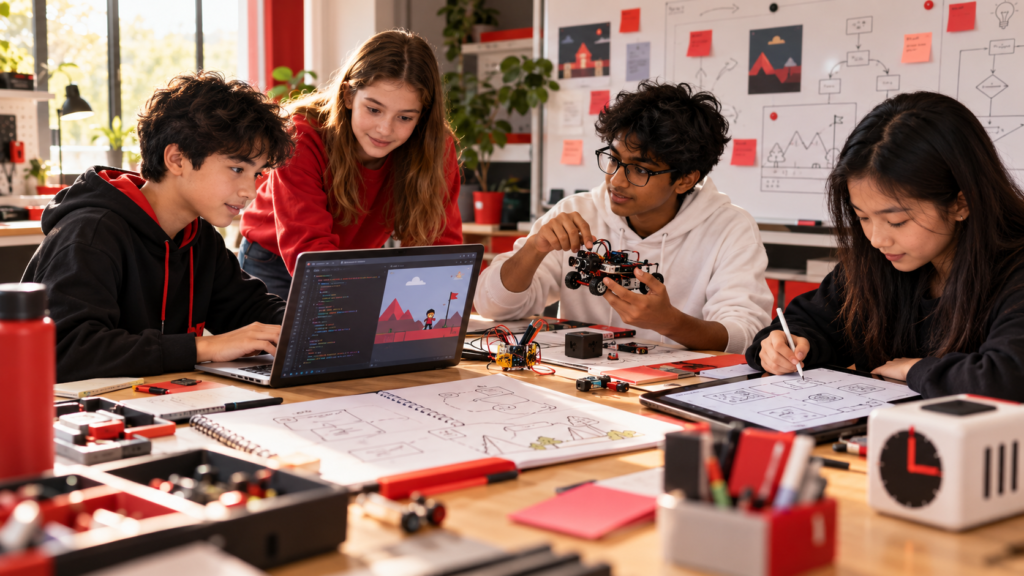
“My child has started coding. Should they participate in a competition?”
It sounds like a simple question, but the answer depends on what the competition is designed to test.
Some coding competitions focus on solving programming problems quickly. Others ask students to build games, websites, robots, or applications. Hackathons may centre on creating something around a theme within a limited period. Beginner coding challenges can simply give children a structured problem to solve.
That means coding competitions for kids are not one single experience.
Used thoughtfully, they can give children a reason to apply what they have learned, work under constraints, encounter unfamiliar problems, and see how other students approach technology. But competition should support learning, not turn coding into a race for certificates or rankings.
What Are Coding Competitions for Kids?
A coding competition is any structured event where students use programming or technology skills to complete a challenge.
Formats can vary considerably.
A student might be asked to:
- solve several programming problems
- build a simple game
- create a website around a theme
- develop a small application
- program a robot to complete a task
- collaborate on a technology solution
- debug an existing program
- present and explain a finished project
Some events are individual, while others involve teams.
Some prioritise technical accuracy and speed. Others assess creativity, design, functionality, presentation, or problem-solving.
Understanding the format is important because different children may enjoy very different kinds of coding challenges.
Are Coding Competitions Good for Kids?
They can be, provided the difficulty level and format suit the learner.
A useful competition should stretch a child without making the challenge completely inaccessible.
For example, a beginner who understands basic Python may enjoy a small challenge involving variables, loops, and conditions.
The same learner may feel completely lost in a competition built around advanced algorithms.
The question for parents should therefore not be:
“Is this competition prestigious?”
A more useful question is:
“Will my child understand enough to participate meaningfully?”
Participation becomes educational when students can attempt the problem, make decisions, and learn from the process.
Competitions Give Coding a Clear Goal
Children often learn individual programming concepts without immediately seeing how they fit together.
A coding challenge creates a reason to use those concepts.
Imagine a student has learned:
variables
conditions
loops
functions
basic user input
During ordinary exercises, each concept may appear separately.
A competition might ask them to build a small interactive program within a fixed time. Suddenly, the learner has to decide which ideas belong together.
This is where structured challenges can become useful.
The task provides a destination, but the student still has to work out how to reach it.
Time Limits Can Teach Prioritisation
Many student coding events have deadlines.
That does not mean children should be encouraged to rush through code.
Instead, time constraints can introduce an important project skill: prioritisation.
Suppose a teenager has three hours to build a simple game.
Their original idea includes:
five levels
multiple characters
custom animations
a scoring system
sound effects
a menu
a leaderboard
They quickly discover that completing everything may not be realistic.
Now they have to ask:
Which feature is essential?
What can be simplified?
What should work first?
This is useful project thinking.
The lesson is not “code faster.”
It is “decide what matters most.”
Hackathons Can Encourage Collaborative Problem-Solving
Student hackathons often involve teams rather than individuals.
This creates a different type of learning.
One student may enjoy programming.
Another may be comfortable with visual design.
Someone else might organise the project or explain the final idea.
Technology projects frequently require these abilities to work together.
Children may need to discuss:
who will build which feature
how separate pieces will connect
what to do when two ideas conflict
how to explain the project
what can realistically be finished
The ability to collaborate around a technical problem is different from simply sitting beside another student while both follow instructions.
Not Every Child Will Enjoy Competitive Programming
There is an important distinction between coding competitions and competitive programming.
Competitive programming often involves solving algorithmic problems under time constraints.
For some students, this can be exciting. They enjoy puzzles, optimisation, logical challenges, and finding efficient solutions.
Other students may prefer building.
They might be more engaged by creating:
games
websites
interactive stories
robots
applications
AI experiments
Neither preference indicates a stronger or weaker programmer.
They simply represent different ways of engaging with technology.
Parents should be careful not to assume that a child who dislikes timed programming contests dislikes coding itself.
Beginners Should Not Measure Progress by Rankings
A competition naturally produces comparison.
Who finished first?
Who received an award?
Whose project was selected?
For children, this can easily become the main focus if adults emphasise results too heavily.
A more useful post-competition conversation might be:
What problem was hardest?
What did you figure out yourself?
What did another participant do differently?
What would you change next time?
What new concept did you encounter?
A student who does not win can still leave with a clearer understanding of programming, project planning, teamwork, or debugging.
That learning should not disappear simply because someone else received a higher score.
Coding Challenges Can Reveal Skill Gaps
Competitions can also act as useful diagnostic experiences.
A child may discover that they understand syntax well but struggle to plan a solution.
Another student may have good ideas but find debugging difficult.
Someone else might build successfully but struggle to explain their project.
These moments provide information about what the learner should practise next.
This makes coding challenges especially useful when they are treated as part of learning rather than as a final test of ability.
How Should Kids Prepare for Coding Competitions?
Preparing does not need to mean months of intense coaching.
For many beginner and intermediate events, the best preparation is consistent practical coding.
Students can practise:
Solving unfamiliar problems
Instead of repeating familiar exercises, try questions where the required programming concept is not stated in advance.
Building small projects within limits
Give the student a simple goal and a fixed amount of time.
For example:
“Build the smallest playable version of this game in 60 minutes.”
Debugging independently
Students should become comfortable reading errors, checking assumptions, and testing sections of code.
Explaining their approach
If the event includes presentations or judging, students should be able to explain what they built and why.
Structured learning can help children develop these foundations before participating in competitions. At CodingZen, practical and project-based coding learning can expose students to building, debugging, experimentation, and independent decision-making across areas such as programming, Python, AI, robotics, game development, and web development.
The aim should be preparation through understanding, not simply training a child to reproduce competition answers.
How Parents Can Choose the Right Coding Competition
Before registering, look beyond the event title.
Consider:
- recommended age
- expected programming level
- technologies required
- individual or team format
- competition duration
- whether beginners are welcome
- whether students build or solve problems
- judging criteria
- what preparation is expected
A 10-year-old who enjoys visual game development may benefit from a very different event than a 16-year-old interested in algorithms.
The best challenge is one that sits slightly beyond the student’s current comfort zone without being completely disconnected from what they know.
What If a Child Gets Stuck During the Event?
Getting stuck is normal.
In fact, competitions often expose students to problems they have not seen before.
Parents and mentors should resist evaluating the experience only by whether the child finished.
A student who spends an hour investigating why something fails may be doing meaningful technical work.
The important questions are:
Did they try different approaches?
Could they identify the problem?
Did they ask a useful question?
Did they learn something they can apply later?
Programming rarely consists of uninterrupted success.
Competitions can make this visible in a concentrated way.
Competitions Should Complement Regular Learning
Coding contests can provide motivation, novelty, and challenge.
They should not replace foundational learning.
A student still needs time to:
understand concepts
build projects without pressure
experiment
make mistakes
ask questions
revisit difficult topics
work creatively
Competition is one environment for applying skills.
It is not the entire learning process.
Children who enjoy coding should also have opportunities to create without scores, rankings, deadlines, or judges.
That balance helps keep technology learning exploratory rather than purely performance-driven.
Conclusion
Coding competitions for kids can be valuable when the event matches the child’s age, skills, interests, and learning stage.
They can provide opportunities to solve unfamiliar problems, work under constraints, collaborate, prioritise features, debug independently, and apply concepts outside regular lessons.
But the real value of a competition should not be reduced to winning.
A child may leave without a prize and still discover how to plan better, ask clearer questions, handle pressure, or approach a technical challenge differently.
For parents considering a coding competition, focus less on the certificate and more on the experience.
The best question after the event may not be:
“Where did you rank?”
It may be:
“What did you learn that you did not know before?”
CTA
If your child is interested in coding challenges, hackathons, or technology projects, building strong foundations first can make these experiences more meaningful. Explore CodingZen’s project-based learning across coding, Python, AI, robotics, game development, web development, and other technology skills.
FAQs
What age can kids start coding competitions?
There is no single ideal age. Some events are designed for young beginners, while others require more advanced programming. Parents should check the expected skill level rather than relying only on age.
Are coding competitions suitable for beginners?
Yes, if the competition specifically supports beginners and uses concepts they can reasonably attempt. A highly advanced algorithm contest may not be appropriate for a new learner.
What is the difference between a hackathon and a coding competition?
A hackathon often involves building a project within a limited period, sometimes in teams. Coding competitions may focus more on solving programming problems, although formats vary.
Do kids need to be very fast at coding to participate?
Not necessarily. Some competitions reward speed, while others focus on creativity, functionality, problem-solving, design, or presentation. Check the judging criteria before registering.
How can children prepare for coding competitions?
Regular programming practice, small project building, debugging, solving unfamiliar problems, and explaining their solutions can all help students prepare more effectively.