Imagine your child writes a secret message to a friend:
“MEET ME AT THREE.”
Now imagine someone else finds that message before it reaches its destination.
Anyone who can read English would immediately understand it.
But what if the message looked like this instead?
“PHHW PH DW WKUHH.”
Suddenly, the message is much harder to understand without knowing how it was changed.
This introduces an interesting computer science concept called encryption.
Understanding encryption for kids helps children explore how information can be transformed to protect it from unauthorised access.
From messaging applications to online payments, encryption plays an important role in digital communication.
For children learning programming, it also provides a practical connection between mathematics, coding, and online safety.
What Is Encryption for Kids?
Encryption is the process of transforming readable information into an encoded form using a mathematical method and, typically, a secret key.
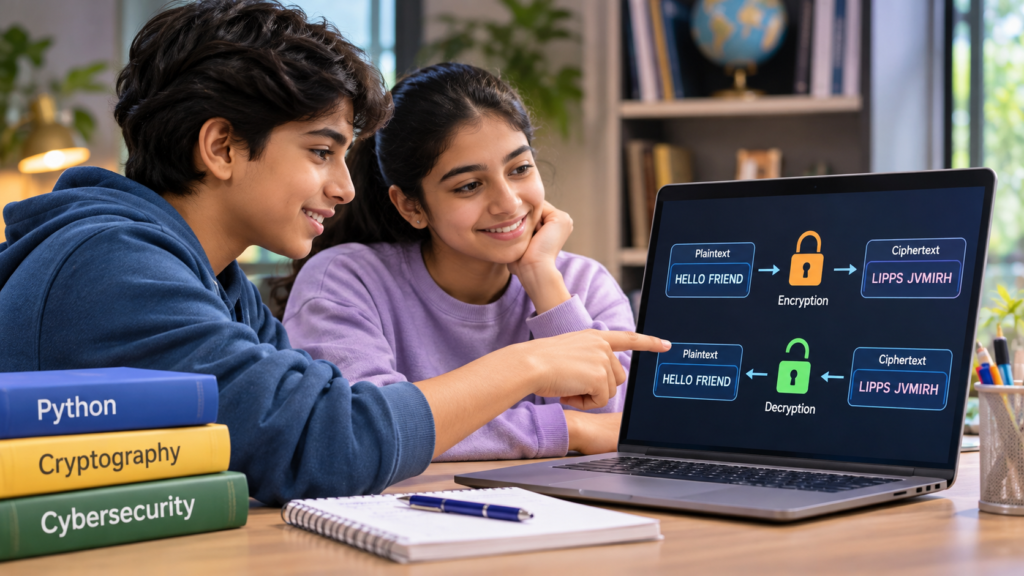
The original readable information is called plaintext.
After encryption, the transformed information is called ciphertext.
Decryption is the process of converting encrypted information back into its readable form using the appropriate key.
For example, a simple encryption activity might replace each letter in a message with another letter according to an agreed rule.
The receiver needs to understand that rule to recover the original message.
However, real-world encryption uses much more sophisticated mathematical techniques than simple letter substitutions.
The purpose is to make information difficult for unauthorised people to understand, even if they obtain the encrypted data.
How Does Encryption Work? A Simple Example
One beginner-friendly way to introduce cryptography is through a Caesar cipher.
This historical substitution technique shifts letters forward or backward through the alphabet.
Understanding the Caesar Cipher
Suppose every letter moves three positions forward.
A becomes D.
B becomes E.
C becomes F.
Using this rule, the word “CAT” becomes “FDW.”
To decrypt the message, the receiver shifts each letter three positions backward.
This activity demonstrates two important ideas:
- Information can be transformed according to a defined rule.
- Someone who knows the rule can reverse the transformation.
However, a Caesar cipher is not suitable for protecting real information because it can be broken easily.
It is useful as an educational introduction, not as a modern security solution.
Why Is Learning About Encryption Important for Children?
Children interact with digital systems long before they fully understand how those systems manage information.
They may use messaging applications, educational websites, online games, and other internet-connected platforms.
Learning about encryption introduces the idea that information travels between devices and may require protection.
It also helps children distinguish between keeping information private and making it permanently invisible.
For example, an encrypted message may be protected while travelling between devices, but someone who gains access to an unlocked device might still read it.
This distinction encourages a more accurate understanding of digital safety.
Encryption is one important security measure, but it does not replace strong passwords, appropriate privacy settings, or careful online behaviour.
Different Types of Encryption Explained Simply
Modern encryption systems use mathematical algorithms and keys to protect information.
Two important approaches are symmetric and asymmetric encryption.
Symmetric Encryption
Symmetric encryption uses the same secret key to encrypt and decrypt information.
Imagine two friends sharing a special key that allows them to lock and unlock the same message box.
Both need access to that key.
If someone else obtains it, they may also be able to read the protected information.
Modern symmetric encryption uses advanced mathematical algorithms rather than physical locks or simple letter substitutions.
Asymmetric Encryption
Asymmetric encryption uses two mathematically related keys.
One is public, while the other is private.
The public key can be shared openly.
The private key must be protected.
In one common application, someone can encrypt information using a recipient’s public key, while the recipient uses their corresponding private key to decrypt it.
This approach helps solve certain challenges involved in securely exchanging information.
Children do not need to understand the mathematics immediately. Recognising the difference between shared-secret and public-private key systems is a useful starting point.
Where Do Children Encounter Encryption in Everyday Life?
Encryption is not limited to computer science laboratories.
It forms part of many familiar digital experiences.
Messaging Applications
Some messaging services use end-to-end encryption.
This is designed so that message content can be read by the communicating endpoints rather than intermediaries transmitting the messages.
However, the exact protections depend on the service, its settings, and how devices are secured.
Secure Websites
When a website uses HTTPS, encryption helps protect information transmitted between the browser and website.
This is particularly relevant when entering login credentials or other sensitive details.
However, HTTPS alone does not prove that a website or business is trustworthy.
A fraudulent website may also use an encrypted connection.
Online Games and Learning Platforms
Online services may use encryption to protect information exchanged between users’ devices and their servers.
Understanding this helps children recognise that the applications they use depend on multiple technologies working together.
A Simple Encryption Activity Children Can Try
Parents can introduce secret-message coding without requiring advanced programming knowledge.
Start with a basic substitution activity.
Step 1: Create a Secret Rule
Choose a number between one and 25.
For example, select four.
Every letter in the message will move four positions forward through the alphabet, wrapping around after Z.
Step 2: Write a Message
Choose a short phrase such as:
“HELLO FRIEND.”
Apply the rule to each letter.
The encrypted result becomes:
“LIPPS JVMIRH.”
Step 3: Exchange Messages
Ask another family member to decode the message using the same rule.
Then change the shift value and repeat the activity.
Step 4: Discuss Its Limitations
Ask children what might happen if someone discovers the shift number.
Could they decode every message written using the same rule?
Could someone try all possible shifts?
These questions introduce the difference between a secret-looking message and genuinely secure encryption.
How Can Children Explore Encryption Through Python?
Once students understand basic substitution, they can explore how programming automates the process.
For example, Python can be used to create a Caesar cipher.
def encrypt(message, shift):
    result = ""

    for character in message.upper():
        if "A" <= character <= "Z":
            position = ord(character) - ord("A")
            new_position = (position + shift) % 26
            result += chr(new_position + ord("A"))
        else:
            result += character

    return result

print(encrypt("HELLO FRIEND", 4))
Output:
LIPPS JVMIRHThis example introduces several programming concepts, including loops, functions, character conversion, and modular arithmetic.
Students can experiment by changing the message or shift value.
The activity also provides an opportunity to discuss why simple educational ciphers cannot replace modern cryptographic systems.
How Does Encryption Connect With Coding Education?
Encryption combines different areas of learning.
Students can explore mathematical patterns, develop programming instructions, and observe how small changes affect an algorithm’s output.
They can also begin asking more thoughtful questions about digital privacy.
For example:
How does a messaging application protect information?
Why do websites use secure connections?
What happens if an encryption key is exposed?
These questions introduce cybersecurity as an area of computer science that involves both technical knowledge and responsible decision-making.
At CodingZen, our project-based coding education approach encourages children to understand how technology works through practical exploration.
An educational encryption project offers a meaningful way to connect programming fundamentals with real-world digital systems.
How Parents Can Support Cybersecurity Learning at Home
Parents do not need specialist technical knowledge to introduce basic digital security concepts.
Begin with everyday questions.
Ask children what information they would feel comfortable sharing publicly and what they would prefer to keep private.
Discuss why passwords should not be shared casually.
Explain that encrypted communication helps protect data but cannot prevent every online risk.
For children interested in technology, coding activities can provide opportunities to explore these concepts more deeply.
The objective is to develop curiosity alongside a realistic understanding of digital safety.
Conclusion: Understanding Encryption Helps Children Look Beyond the Screen
Learning about encryption for kids introduces children to an important part of how digital information is protected.
Through simple secret-message activities, students can explore the relationship between plaintext, ciphertext, keys, and algorithms.
As their programming knowledge develops, they can investigate more advanced concepts and discover how encryption supports digital communication.
The most valuable starting point is understanding that technology involves systems and decisions that are not always visible to the user.
At CodingZen, we believe children should have opportunities to explore these hidden systems through practical coding and meaningful projects.
Explore CodingZen’s online coding programmes to discover how hands-on technology education can help children move beyond simply using digital tools towards understanding how they work.
Frequently Asked Questions
1. What is encryption in simple words for kids?
Encryption is a process that transforms readable information into an encoded form to protect it from unauthorised access. Someone with the appropriate key can decrypt the information and read the original message.
2. What is the difference between encryption and decryption?
Encryption converts readable information into ciphertext using an encryption method. Decryption reverses that process using the appropriate key or information needed to recover the original message.
3. Can children learn encryption through coding?
Yes. Children can begin with simple ciphers and gradually explore encryption concepts through programming activities. Python can be used to demonstrate how algorithms transform messages, although educational ciphers are not suitable for securing real data.
4. Is encryption the same as cybersecurity?
No. Encryption is one technique used in cybersecurity. Cybersecurity also involves protecting devices, networks, accounts, applications, and information from different threats.
5. Is the Caesar cipher secure enough for real messages?
No. The Caesar cipher is easy to break because it has very few possible shift values. It is useful for demonstrating the basic idea of encoding messages but should not be used to protect sensitive information.