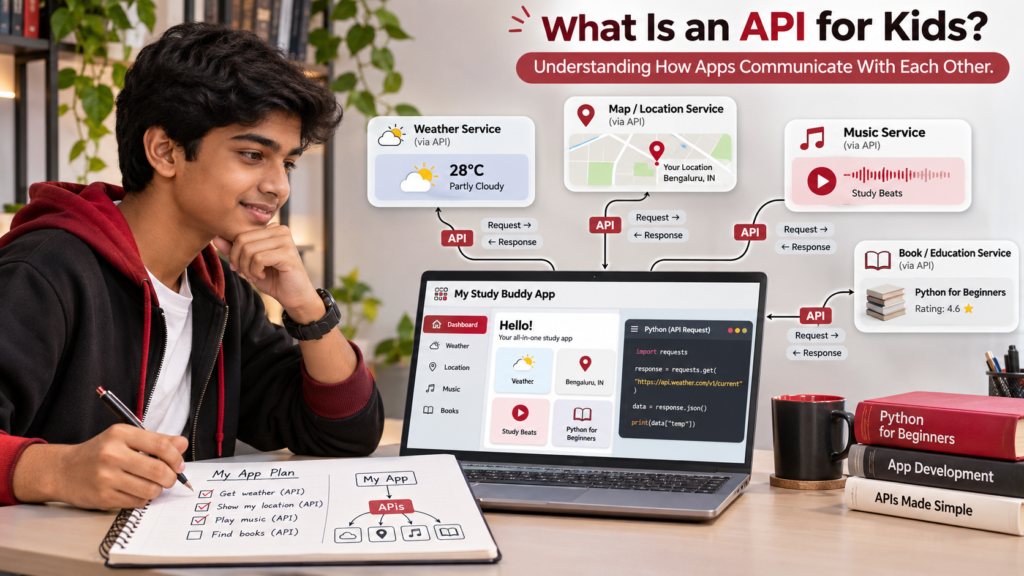
Your child checks the weather on a smartphone, opens a map to find a nearby restaurant, and uses a music application to search for a favourite song.
These applications appear completely different, but many rely on a similar technical concept to access information and provide useful features.
That concept is called an API.
If your teenager has started learning Python, JavaScript, or application development, understanding what an API is for kids can introduce an exciting new perspective on how software works.
Instead of building every feature from scratch, developers can use APIs to connect applications with existing services and information.
But how does this actually work, and why should young programmers understand it?
What Is an API for Kids?
API stands for Application Programming Interface.
In simple terms, an API provides a defined way for one software application to communicate with another system.
Imagine ordering food at a restaurant.
You choose something from the menu and tell the waiter what you want. The waiter communicates your order to the kitchen and returns with the response.
You do not need to enter the kitchen or understand every step involved in preparing the meal.
An API works in a somewhat similar way.
An application sends a request to another system through an established interface. That system processes the request and returns an appropriate response.
The application can then use the returned information to perform a task.
This explanation is simplified, but it helps beginners understand the relationship between requests, responses and software systems.
How Do APIs Work in Real-Life Applications?
APIs are used across many digital experiences that children already recognise.
Understanding these examples can make an unfamiliar programming concept easier to explore.
1. Weather Applications
Suppose a student creates a website displaying the current temperature in different cities.
Collecting weather measurements independently would require specialised equipment and infrastructure.
Instead, the application can request weather information from a suitable weather data service through an API.
The service provides a response containing information such as temperature, humidity or weather conditions, depending on the API.
The student’s application can then display that information in a readable format.
2. Maps and Location Features
Some websites display interactive maps to help visitors understand where a location is situated.
Developers can integrate mapping functionality through APIs provided by mapping services.
Rather than building an entire mapping system independently, they can use the available interface according to the provider’s documentation and permissions.
3. Educational Applications
Imagine an application that displays information about planets.
Instead of manually entering every detail, a developer could retrieve suitable astronomy data from a publicly accessible educational API.
This allows the application to work with information provided by another system.
However, the quality and reliability of the final experience still depend on the data source and how the application handles its responses.
Understanding API Requests and Responses
One of the most important concepts in API programming for students is the request-response process.
Consider a simple application that displays information about a country.
The interaction might follow these steps:
- The student enters a country name.
- The application sends a request to an appropriate data API.
- The API service processes the request.
- The service returns information in a structured format.
- The application displays selected details to the user.
For example, the response might contain the country’s capital, population and currency.
The student then decides which information should appear on the screen.
This introduces an important distinction.
The API provides access to information or functionality, while the developer decides how to use it within the application.
What Is JSON, and Why Is It Used With APIs?
Many web APIs exchange information using a format called JSON.
JSON stands for JavaScript Object Notation.
It represents structured information using simple combinations of names, values, lists and objects.
For example, an imaginary API response about a book might look like this:
{
  "title": "The Secret Garden",
  "author": "Frances Hodgson Burnett",
  "available": true
}
The information is organised into clearly labelled fields.
A program can read these fields and display the book title, author and availability status.
Although JSON may initially resemble programming code, it is primarily a data-interchange format.
Learning to interpret structured information helps students understand how applications receive and organise external data.
When Should Children Start Learning APIs?
Not every beginner needs to study APIs immediately.
Students generally benefit from understanding basic programming concepts before moving towards application integration.
Start With Programming Fundamentals
Before exploring APIs, learners should be reasonably comfortable with concepts such as variables, functions, conditions and basic data structures.
For students learning Python, familiarity with dictionaries and lists can be particularly useful.
These concepts help them understand how to handle the information returned by an API.
Introduce Simple Data-Based Projects
Once students understand basic programming logic, they can begin exploring projects involving external information.
A beginner might retrieve a small amount of public data and display it in a readable format.
More experienced students may explore search functions, filtering and updating information.
Learning progression should depend on programming experience rather than age alone.
Can Kids Use APIs With Python?
Yes. Python is one language that can be used to communicate with web APIs.
For example, a student developing a simple educational application could use Python to request information from a suitable public data source.
The program might then organise and display the returned results.
Through this process, learners can practise several useful concepts:
- Sending requests to external services
- Reading structured data
- Working with Python dictionaries
- Checking whether a request succeeded
- Handling missing information or errors
Students should begin with documented, age-appropriate APIs that permit educational use.
Some services require registration, access credentials or payment, so parents and educators should review the terms before students use them.
What Should Parents Know About API Safety?
Although APIs are useful learning tools, beginners should understand a few important precautions.
Some APIs require authentication using an API key, which identifies or authorises access to a service.
These keys should not be publicly shared or placed carelessly into published code.
Students should also learn that externally retrieved information is not automatically accurate, safe or appropriate.
A reliable application needs to handle unexpected responses, service failures and potentially unsuitable information.
For children’s projects, supervised use of trusted documentation, publicly permitted datasets and fictional test information is a sensible starting point.
Introducing these practices early helps learners understand that working software also requires responsible development decisions.
How API Learning Connects With Project-Based Coding at CodingZen
Understanding programming syntax is one part of learning to code. Applying that knowledge to build meaningful applications introduces additional challenges.
At CodingZen, the emphasis on structured, hands-on coding education encourages children to explore concepts through practical creation rather than simply memorising instructions.
For students progressing towards more advanced programming, APIs represent a useful area of exploration because they connect foundational concepts with real software interactions.
Understanding how applications exchange information can help teenagers recognise the relationship between different components of a digital product.
Rather than treating an application as one mysterious system, students begin seeing how information moves between services and interfaces.
This broader understanding supports more informed experimentation with programming.
Conclusion: APIs Help Children Understand Connected Technology
Exploring an API for kids introduces students to an important concept behind many familiar digital experiences.
From weather applications to educational platforms, APIs enable software systems to exchange information through defined interfaces.
For beginners, the objective is not to master complex integrations immediately.
It is to understand how requests, responses and structured data work together.
As students develop their programming knowledge, they can gradually explore how these concepts are used in practical applications.
Parents interested in supporting this progression can encourage learning experiences that connect technical understanding with hands-on experimentation.
Explore CodingZen’s online coding education programmes and discover how project-based learning can help your child progress from programming fundamentals towards creating more capable digital applications.
Frequently Asked Questions
1. What is an API in simple words for kids?
An API is a way for different software systems to communicate. It allows an application to request information or functionality from another system through a defined interface, without needing to understand all its internal operations.
2. Is API programming difficult for beginners?
API programming introduces concepts such as requests, responses and structured data. Beginners who understand variables, functions and basic data structures may find introductory API activities more approachable. The difficulty depends on the API and the project.
3. Can children learn APIs using Python?
Yes. Python can communicate with web APIs and process the returned information. Students can begin with suitable public data APIs and gradually explore more advanced integrations as their programming skills develop.
4. Do students need to know web development before learning APIs?
Not necessarily. Basic programming knowledge is more important for introductory API activities. Web development experience can be helpful, especially when students want to display API information on websites.
5. Are APIs free for students to use?
Some APIs provide free public access or limited free usage, while others require registration, payment or access credentials. Parents and educators should review documentation, usage limits and privacy requirements before choosing an API for a student project.