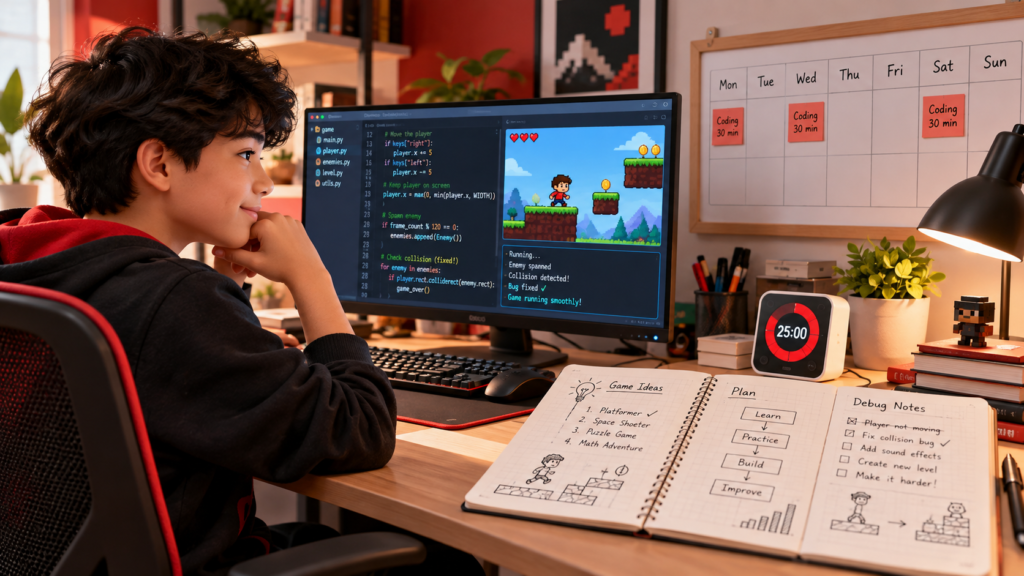
“My child has one coding class a week. Is that enough, or should they be practising every day?”
Parents ask this because programming looks like a skill that requires constant practice. But more time does not automatically mean better learning.
If you are wondering how often should kids practice coding, the more useful answer is not “every day.” It depends on the child’s age, experience, attention span, current project, and how the practice is structured.
For most learners, short and consistent practice is more useful than occasional marathon sessions.
The goal is not to make children spend as many hours as possible in front of code. It is to give them enough regular exposure to remember concepts, experiment independently, and gradually become more confident builders.
How Often Should Kids Practice Coding?
For many beginners, coding two to four times per week can be a practical starting point.
That does not mean every session needs to be a formal lesson.
A week might include:
- One structured coding class
- One short practice session
- One project-building session
- An optional session for experimenting or improving something already built
A younger child may need shorter, more playful sessions.
A teenager working on a larger Python, game development, robotics, or web project may naturally spend longer.
The important factor is continuity.
If a child learns a new concept and then does not use it again for several weeks, they may spend the next session trying to remember what they previously understood.
Regular practice helps keep those ideas active.
How Long Should a Child Practice Coding?
Parents sometimes assume coding sessions need to last an hour to be useful.
They do not.
A focused 20-minute session can be valuable if the child is actively solving a problem.
The right length varies by age and experience.
Younger Learners
Children who are still developing concentration may benefit from shorter sessions of around 15 to 30 minutes.
The session could involve:
- Modifying a game
- Completing one small challenge
- Fixing an error
- Adding a character interaction
- Experimenting with a new command
Stopping while the child is still interested can be better than extending the session until frustration takes over.
Older Children and Teenagers
Older learners may work comfortably for 30 to 60 minutes, particularly when they are building something they chose themselves.
Project work often creates natural momentum.
A teenager designing a website or debugging a game may not experience the activity as “practice” in the same way they would experience a worksheet.
That is one advantage of project-based coding education.
Practice Should Not Mean Repeating the Same Exercise
Good coding practice is different from memorising multiplication tables.
Programming develops through application.
If a child learned loops during a lesson, useful practice might involve finding another place where a loop could solve a problem.
For example:
Instead of repeatedly writing the same movement command, can the learner create a loop?
Can the loop stop under a particular condition?
Can they adjust it so that it behaves differently?
This type of practice forces the child to think about the concept rather than simply recognise it.
A Simple Weekly Coding Routine for Beginners
A practical coding routine does not need to dominate the week.
Consider this example.
Session 1: Learn
The child encounters a new concept during a structured class.
Perhaps they learn about variables.
Session 2: Revisit
A few days later, they spend 20 to 30 minutes opening the project again.
They explain what the variable does and make one small change.
Session 3: Apply
Later in the week, they use the same idea differently.
Instead of using a variable for a score, they might use one to track lives, time, or collected objects.
This sequence is useful because it moves through three stages:
Learn.
Recall.
Apply.
That is more meaningful than simply spending three hours coding without a clear purpose.
Why Consistency Matters More Than Intensity
A child can spend three hours on a coding project one Saturday and still struggle to remember the concept two weeks later.
Learning benefits from repeated contact with ideas.
Programming also involves many connected concepts.
Variables interact with conditions.
Conditions interact with events.
Loops may depend on variables.
Functions may combine several pieces of logic.
Frequent exposure gives children opportunities to see these connections repeatedly.
This does not require daily coding.
It simply means avoiding very long gaps when possible.
What Should Kids Actually Do During Coding Practice?
One of the biggest challenges parents face is knowing what “practice coding” means.
It does not need to mean starting a new lesson every time.
Children can practise by:
Improving an Existing Project
Ask them to add one new feature.
A simple game could gain:
- Another level
- A timer
- A scoring system
- Different player controls
- A restart function
Debugging Something That Does Not Work
Errors are useful practice opportunities.
Instead of immediately replacing broken code, children can investigate why the program is behaving differently from what they expected.
Rebuilding a Small Feature From Memory
A learner might close the tutorial and try to recreate one part independently.
This reveals what they actually understood.
Explaining Their Program
Ask the child to explain what one section of code does.
Teaching or explaining a concept often exposes gaps in understanding.
Creating a Variation
If a learner built a quiz, can they turn the same logic into a guessing game?
If they created a score variable, can they use a variable for something else?
These activities help move knowledge beyond one specific example.
Should Children Code Every Day?
Not necessarily.
Daily practice may suit a teenager who is highly interested in programming and chooses to work on personal projects.
It may be unnecessary for a young beginner.
Children already balance school, homework, physical activity, hobbies, social time, and rest.
Coding should fit into that broader routine.
Forcing daily programming simply to maintain a streak can turn an enjoyable creative activity into another obligation.
Consistency matters, but so does motivation.
Two or three focused sessions that a child engages with thoughtfully may be more useful than seven rushed sessions completed reluctantly.
What If a Child Keeps Forgetting Coding Concepts?
Forgetting is normal, particularly for beginners.
Parents should not assume that a child is failing because they cannot immediately recall every command.
Instead, notice what they remember conceptually.
A learner might forget the exact syntax for creating a loop but remember that repetition can be automated.
That distinction matters.
Looking up syntax is common in programming.
The deeper goal is understanding what kind of solution a problem requires.
If a child repeatedly forgets an entire concept, however, they may need more opportunities to use it across different projects.
How Parents Can Support Coding Practice Without Teaching Code
Parents do not need programming knowledge to support a coding routine.
Instead of asking:
“Did you finish your coding homework?”
try asking:
“What are you building?”
“What changed since last time?”
“What problem are you trying to solve?”
“What did you try when it didn’t work?”
These questions focus attention on the learning process.
Parents can also help by protecting a regular time slot, ensuring the child has access to the necessary device, and encouraging them to return to unfinished projects.
The objective is support, not supervision of every line of code.
Structured Learning Can Make Practice More Purposeful
Random coding practice can eventually become repetitive.
Structured progression helps learners understand what to practise next.
At CodingZen, project-based learning allows children to apply concepts through practical creation rather than treating coding as a series of isolated exercises.
A learner might first encounter a concept with guidance, then use it in a project, modify it, test it, and eventually apply it more independently.
This kind of progression helps practice feel connected to something the child is building.
For parents, that also makes progress easier to observe.
Instead of asking how many exercises were completed, they can see how a project becomes more sophisticated as the learner develops.
Signs That a Coding Routine Is Working
You do not need to count hours to judge whether practice is effective.
Look for changes in behaviour.
A productive routine may lead to a child who:
- Needs less help with familiar concepts
- Starts experimenting independently
- Can explain parts of their code
- Notices errors and attempts fixes
- Reuses ideas from earlier projects
- Begins planning before coding
- Adds personal features without being prompted
These behaviours suggest that practice is building understanding rather than simply increasing screen time.
Avoid Turning Coding Into Another Race
Parents naturally want to see progress.
But programming is not a skill where faster always means better.
One child may move quickly through tutorials but struggle to build anything without instructions.
Another may spend longer on a smaller project because they are experimenting with several solutions.
The second learner may be developing valuable independence.
Rather than asking how quickly a child can complete a curriculum, ask how confidently they can use what they have learned.
Finding the Right Coding Practice Balance
So, how often should kids practice coding?
There is no universal number, but regular, manageable sessions usually make more sense than intensive bursts followed by long gaps.
For many beginners, two to four coding touchpoints each week can provide enough continuity without overwhelming the child.
Those sessions do not all need to be classes. They can involve building, modifying, debugging, explaining, or experimenting.
The best routine is one that a child can sustain while remaining curious.
CodingZen encourages children to learn technology through practical, project-based experiences where practice has a purpose. If you are exploring structured coding education for your child, look for a learning path that balances instruction with enough space to experiment independently.
The objective is not to create the busiest coding schedule.
It is to create a routine that helps a child keep learning.
FAQs About Coding Practice for Kids
1. How many days a week should a child practise coding?
For many beginners, two to four sessions per week can provide useful consistency. The ideal frequency depends on age, interest, experience, and the complexity of what the child is learning.
2. Is 30 minutes of coding practice enough?
Yes, especially for beginners. A focused 20 to 30-minute session spent building or solving a problem can be more useful than a longer distracted session.
3. Should children practise coding every day?
Daily practice is not essential for most children. Learners who are highly interested may choose to code frequently, but a sustainable routine is generally more important than maintaining a daily streak.
4. What should children do between coding classes?
They can revisit projects, modify features, debug errors, recreate something from memory, or apply a recently learned concept in a new way.
5. How can parents help children practise coding at home?
Parents can create regular practice time, ask children to explain their projects, encourage experimentation, and focus on progress rather than the number of completed exercises. Programming knowledge is not required to provide useful support.