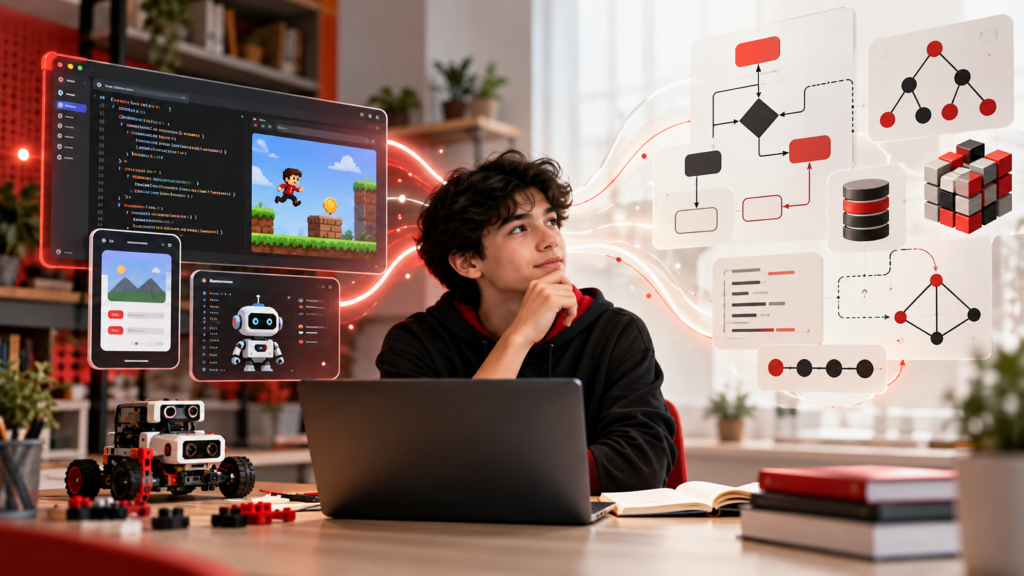
“My child is learning coding. Does that mean they are learning computer science?”
It is a reasonable question.
The terms coding, programming, technology and computer science are often used interchangeably when discussing children’s education. They are closely connected, but they do not mean exactly the same thing.
Coding teaches a child how to give instructions to a computer.
Computer science goes further. It helps children understand the ideas behind those instructions, how computers solve problems, how information is organised, how systems work and how technology can be designed.
Understanding coding vs computer science for kids can help parents look beyond the programming language being taught and focus on what their child is actually learning.
What Is Coding for Children?
Coding is the process of writing instructions that a computer can understand and execute.
For a beginner, these instructions might make a character move across a screen, repeat an animation or respond when a button is clicked.
As children progress, coding can be used to create:
- Games
- Websites
- Interactive stories
- Small applications
- Automated programs
- Robotics projects
- Data-based projects
Children may begin with visual programming tools before eventually using text-based languages such as Python or JavaScript.
Coding is therefore an important practical part of technology education.
But knowing how to write code is only one part of understanding computing.
What Is Computer Science for Kids?
Computer science for kids introduces the broader principles behind computing and digital systems.
A child learning computer science might explore questions such as:
Why does an algorithm work?
How can a large problem be divided into smaller problems?
How does a computer store information?
Why is one solution more efficient than another?
How does a website communicate with a server?
How can a program make decisions?
What happens when software receives incorrect input?
These questions involve coding, but they also develop an understanding of how computational systems operate.
A strong computer science education therefore combines practical creation with conceptual understanding.
Coding vs Computer Science for Kids: A Simple Example
Imagine that a child wants to build a maze game.
Learning coding may involve writing instructions such as:
Move the player when an arrow key is pressed.
Detect whether the player touches a wall.
Increase the score when the player collects an object.
Move to the next level when the player reaches the exit.
These are valuable programming skills.
Computer science thinking appears when the child starts asking deeper questions.
How should the maze be represented?
What information needs to be stored?
What should happen when two events occur at the same time?
Can the same section of code be reused instead of written repeatedly?
How can the game recognise the shortest route?
Now the child is not simply writing commands. They are designing a system.
That difference is important.
Computer Science Teaches Ideas That Exist Beyond One Programming Language
Programming languages change.
The underlying concepts often remain useful.
A child might begin learning loops in a visual coding environment and later encounter the same idea in Python. The syntax will look different, but the reasoning remains familiar.
The same applies to concepts such as:
Algorithms
An algorithm is a sequence of steps used to solve a problem.
Children encounter algorithmic thinking whenever they decide what should happen first, next and under particular conditions.
Variables
Variables allow programs to store changing information.
A game might use variables to track points, remaining lives or time.
Conditions
Conditions help programs make decisions.
For example:
If the player’s score reaches 100, unlock the next level.
Loops
Loops repeat instructions without requiring the programmer to write the same command many times.
Decomposition
Decomposition means breaking a large challenge into smaller, manageable tasks.
Instead of thinking, “I need to build an entire game,” a learner might separate the problem into player movement, scoring, obstacles and levels.
These concepts are more transferable than memorising the exact spelling of individual commands.
Why Parents Should Look Beyond “Which Language Is My Child Learning?”
Parents often ask whether their child should learn Python, JavaScript or another programming language.
The language matters, especially as children progress.
But it should not be the only measure of learning quality.
Consider two students.
One student can copy a 40-line Python program from a tutorial and run it successfully.
Another student creates a smaller program independently, encounters an error, identifies the problem and changes the logic until it works.
The second project may appear simpler, but it could involve considerably more genuine understanding.
Parents can therefore ask questions such as:
“What did you decide while building this?”
“What part did not work at first?”
“How did you fix it?”
“What would you change if you built it again?”
“What does this piece of code actually do?”
These questions reveal far more about learning than simply asking whether a project was completed.
What Should a Well-Rounded Coding Education Include?
A good learning path should gradually move beyond following instructions.
Understanding Before Complexity
A child does not need complicated projects immediately.
It is often more useful to understand a simple concept deeply than to complete an impressive-looking project without knowing how it works.
Building Projects
Concepts become more meaningful when children apply them.
A lesson on conditions becomes easier to understand when the child uses conditions to control a game.
A lesson on variables becomes practical when variables control a score.
Debugging
Programs rarely work perfectly on the first attempt.
Finding and correcting errors teaches children to inspect their assumptions, test different possibilities and improve their solutions.
Independent Decisions
As learners progress, projects should contain opportunities for choice.
Children can decide what the project should do, how it should look or how a particular feature should work.
That shift moves them from following instructions toward designing solutions.
Reflection
After finishing a project, children should be able to explain what they created.
Being able to describe the logic behind a program is often a strong indicator that the child understands the concept rather than simply remembering the steps.
How Computational Thinking Fits Into Computer Science
Another phrase parents may encounter is computational thinking.
Computational thinking does not simply mean thinking like a computer.
It describes ways of approaching problems that are useful in computer science.
These can include:
- Breaking problems into smaller parts
- Identifying patterns
- Designing step-by-step solutions
- Testing different approaches
- Removing unnecessary complexity
- Improving a solution after testing it
Coding gives children a practical environment in which to practise these habits.
A program provides immediate feedback. Either the intended behaviour happens or something needs investigation.
This makes programming particularly useful for experimentation.
Should Children Learn Coding or Computer Science?
Parents do not necessarily need to choose between them.
Coding is one of the best ways for children to experience computer science concepts in practice.
The more useful question is:
“Is my child only learning how to type code, or are they also learning how to think about what the code is doing?”
For younger learners, this may begin with simple sequences, games and visual programming.
Older children can gradually explore deeper concepts through Python, web development, AI, robotics, game development and other areas of computing.
The difficulty should grow with the learner’s understanding rather than simply introducing more complicated terminology.
How CodingZen Approaches Technology Learning
At CodingZen, the goal of coding education is not simply to help children reproduce programs.
Hands-on, project-based learning gives learners opportunities to understand concepts by using them.
When children build, test, make mistakes, modify their ideas and try again, programming becomes more than an exercise in remembering commands.
It becomes a way to understand technology through creation.
Structured progression can also help children move from basic coding concepts toward more independent projects as their confidence develops.
The Bigger Question Parents Can Ask
The difference between coding and computer science becomes clearer when we stop asking only:
“What programming language is my child learning?”
and start asking:
“What does my child understand well enough to build independently?”
A child who understands why a program works has something more valuable than a collection of memorised commands.
Coding provides the tools.
Computer science provides the thinking behind those tools.
A strong technology education brings both together.
If you are exploring structured coding education for your child, CodingZen focuses on helping learners understand, experiment and build through practical, age-appropriate projects rather than treating programming as a set of commands to memorise.
FAQs About Coding vs Computer Science for Kids
1. Is coding the same as computer science?
No. Coding is the process of writing instructions for computers. Computer science is broader and includes programming, algorithms, data, computational thinking, systems and other principles related to computing.
2. Should children learn coding before computer science?
The two can be learned together. Children often encounter computer science concepts naturally while building coding projects. A beginner game, for example, can introduce sequencing, loops, conditions and algorithms.
3. What computer science concepts can children learn?
Depending on their age and experience, children can learn concepts such as algorithms, variables, loops, conditions, decomposition, debugging, data structures and computational thinking.
4. Does my child need to memorise programming syntax?
Not initially. Understanding the logic behind a program is usually more useful than memorising commands. Syntax becomes easier with regular practice and repeated use.
5. How can parents tell whether a child understands coding?
Ask the child to explain how their project works, why they made particular decisions, what problems they faced and how they fixed them. Independent explanation and modification can reveal more understanding than simply completing a tutorial.