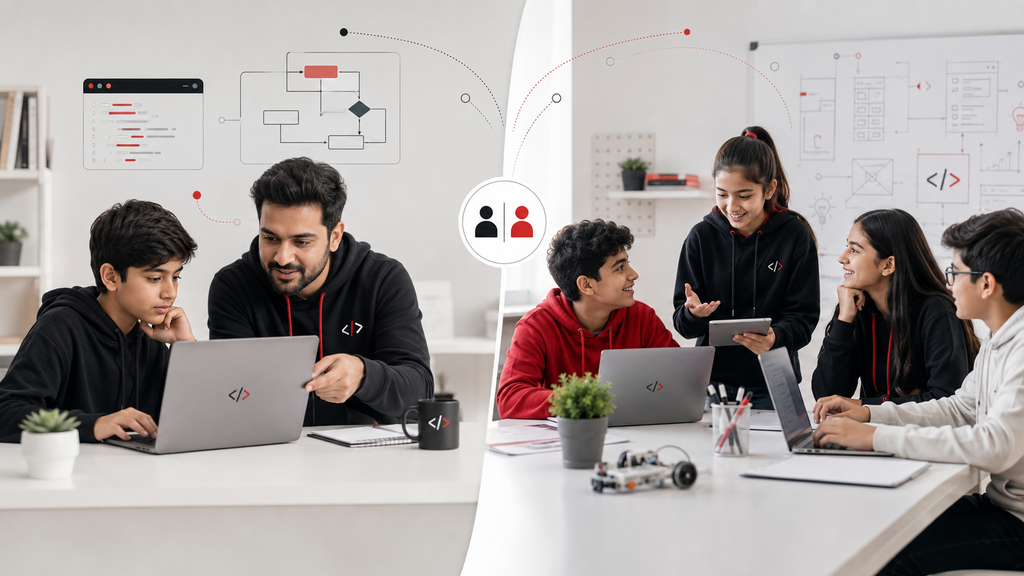
There is no universally better class format
Parents often ask whether one-to-one coding classes are better than group classes. The honest answer is that each format solves a different problem. Private instruction can adapt quickly to one learner’s pace, while a well-run small group can provide discussion, collaboration and healthy comparison. A poor private class may become passive tutoring. A crowded group may leave a child invisible.
The right choice depends on the child’s confidence, attention, experience, goals, schedule and response to other learners. It also depends on details that are easy to ignore: the actual group size, whether students are at similar levels, how projects are reviewed, and whether the instructor has time to observe each child’s reasoning.
Instead of asking, “Which format is best?” ask, “Which environment will help this child think, practise and take ownership?” The answer may change over time. A beginner who needs reassurance may start privately, then join a group. A social learner may begin in a small group but use occasional one-to-one sessions for a capstone project.
What a strong one-to-one class should look like
A strong private coding class is not simply a lecture delivered to one student. The instructor should use the additional attention to diagnose misunderstandings, adjust project difficulty and ask deeper questions.
The child should still do the thinking and control the keyboard. The teacher may demonstrate briefly, then return the task to the learner. If the student is stuck, the instructor should help them describe the problem, inspect the latest change and test one possibility. Constantly giving the answer creates dependence even though the class feels efficient.
Private instruction is particularly useful when a student has an unusual starting level, needs a flexible pace, is preparing a specific project or becomes anxious in groups. It can also help a child who learns quickly and needs extension beyond a standard sequence.
The format works best when goals are documented. Parents should receive evidence of what the learner can do independently, not only a list of topics covered.
What a strong small-group class should look like
A small group should create learning opportunities that private tuition cannot. Students can explain ideas, compare solutions, test each other’s projects and see that mistakes are normal. A peer may ask a question that another child was hesitant to raise.
The value disappears when the group is too large or badly matched. If one student is building a first Scratch animation while another is ready for advanced game logic, the teacher may be forced to teach two different classes at once. Grouping by age alone is not enough; readiness and experience matter.
A strong group lesson includes short instruction, individual building time, teacher check-ins and a moment for students to share or review work. Collaboration should not mean one confident child completes the project for everyone.
CodingZen should state the maximum group size consistently across the website and explain how learners are assessed before placement. Transparency about group structure helps parents evaluate value rather than assuming “small group” has a standard meaning.
Attention and pace
Private instruction offers the greatest flexibility in pace. A student can spend longer on loops, skip a concept already mastered or change the project theme. This is useful for learners whose pace differs significantly from a standard cohort.
Group classes use a shared rhythm. That can be positive. A child learns to listen, manage time and keep moving instead of perfecting one small detail indefinitely. But the instructor needs strategies for early finishers and students who require more explanation.
Parents should ask how a provider handles pace differences. Good answers include extension challenges, differentiated tasks, recorded feedback, short catch-up support and level-appropriate grouping. Weak answers depend entirely on the child “keeping up.”
The fastest pace is not necessarily the best. In private classes, teachers should avoid racing through the syllabus merely because one student can complete guided tasks. In groups, they should avoid slowing everyone to the point where confident learners stop thinking.
Confidence, communication and personality
A shy child may speak more freely in a one-to-one setting, especially during the first few sessions. The absence of peers can reduce fear of being wrong. However, private instruction can also allow a learner to avoid presenting work or hearing different viewpoints.
A small group can help children practise explaining a project, asking for help and responding to feedback. For some learners, seeing peers struggle and improve reduces perfectionism. For others, comparison creates pressure.
Observe how the child behaves in other learning environments. Do they gain energy from sharing ideas? Do they need time before speaking? Do they become distracted by social activity? Do they feel uncomfortable when another student finishes first?
The trial class should reflect the real format. A private demonstration cannot tell a parent how the child will respond in a group. Likewise, a one-time group event may not show how the teacher personalises ongoing learning.
Beginners versus advanced learners
Beginners can succeed in either format. In a small group, they benefit from shared discovery and repeated questions. In a private class, the teacher can adapt to typing speed, reading confidence and early frustration.
Advanced learners often need feedback on architecture, debugging and project decisions rather than continuous instruction. A small advanced cohort can be highly valuable because students review different solutions. Private mentorship may be better when the project is specialised or the learner needs support in a particular technology.
The deciding factor is not simply level. It is the type of feedback required. A beginner may need immediate help with foundational misconceptions. An advanced teenager may need a mentor who can challenge assumptions and reduce project scope.
CodingZen can offer a blended pathway: regular small-group learning for structure and collaboration, with milestone-based one-to-one reviews for capstone projects. Such a model should be described clearly rather than sold as an undefined add-on.
Cost and value
Group classes usually cost less per student because instructor time is shared. Private classes cost more because the full session is reserved for one learner. Price alone does not determine value.
Parents should compare what is included: live teaching hours, instructor experience, curriculum access, project feedback, missed-class policy, recordings, progress reports, parent meetings and technical support. A cheap class that provides little feedback may create less value than a smaller number of high-quality sessions.
Private tuition can become expensive if the child uses class time for work that could be completed independently. A strong instructor sets practice between sessions and uses live time for explanation, review and difficult decisions. Group classes can be efficient when students arrive prepared, but less so when the teacher repeatedly solves setup problems for several learners.
The website should present fees with consistent units. Current CodingZen pages mix hourly, monthly and package pricing, making comparison harder. A clear table should state class format, total hours, group size, scheduling rules and what is included.
Collaboration and peer learning
Programming is often imagined as solitary work, but real technology projects involve communication. Students need to explain decisions, read other people’s code, give feedback and divide tasks responsibly.
A group class can introduce these habits early. Students may test one another’s games, suggest features or compare two ways to solve the same problem. The teacher should create structured collaboration so the most vocal student does not dominate.
Private learners can still collaborate through showcases, code reviews, hackathons or occasional workshops. If one-to-one students never interact with peers, they may build technical confidence without practising communication.
Parents should ask how collaboration is supervised and how individual ownership is protected. A group project should make each student’s contribution visible. Shared work should not become a way to hide unequal participation.
Scheduling and continuity
Private classes often offer greater scheduling flexibility, but excessive flexibility can harm continuity. Constant rescheduling makes learning feel optional and causes projects to lose momentum. A regular weekly slot is usually better, with reasonable policies for unavoidable changes.
Group classes require a fixed schedule. This can support routine and commitment, but missed sessions need a clear catch-up process. Recordings alone may not be enough for a child who needs help applying the concept.
Ask what happens when the instructor is unavailable, when a child misses a class or when a group’s pace changes. Providers should explain replacement sessions, recordings, notes and support without making unrealistic promises.
The best schedule is one the family can sustain. A premium format is not valuable if the child regularly joins tired, rushed or distracted.
How to decide: a practical matrix
Choose one-to-one instruction when the child needs a highly personalised pace, has a specific project, experiences significant anxiety in groups, has an unusual skill level or requires flexible support.
Choose a small group when the child enjoys discussion, benefits from peer examples, needs a more affordable long-term format and can work at a shared pace.
Consider a hybrid when the child needs regular community plus occasional specialist feedback. For example, a student may learn Python fundamentals in a small group, then receive a private review while building a web application.
Do not choose a group merely because it is cheaper or private tuition merely because it sounds premium. Ask for actual group size, instructor allocation and project evidence. A four-student class with active feedback can be more personalised than a distracted private session.
Questions to ask before enrolling
What is the maximum group size, and is it the same for every course?
How are learners assessed before placement?
How much of the class is demonstration versus student building?
Does the child control the keyboard?
How does the teacher respond when a student is stuck?
What extension work is available for fast learners?
How are missed classes handled?
Will parents receive skill-based progress reports?
Can the child change projects or themes?
How often will students present or review work?
Who teaches the class, and will the instructor remain consistent?
What happens if the selected format is not a good fit?
A provider should answer these questions with a process, not only with reassuring adjectives.
Frequently asked questions
Are one-to-one classes always faster? They can move faster, but speed is not the only goal. A child still needs practice, reflection and independent work.
Do group classes distract children? Poorly managed groups can. Well-structured small groups use peer interaction to strengthen explanation and feedback.
What is a reasonable group size? It depends on age, course complexity and instructor support. The provider should state a maximum and demonstrate how every learner receives feedback.
Can a shy child benefit from a group? Yes, if the group is small, psychologically safe and the teacher creates low-pressure ways to participate.
Are private classes better for advanced coding? They are useful for specialised projects, but an advanced peer group can provide valuable code review and different perspectives.
Can the format change later? It should. Learning needs change, and providers should allow movement after assessment rather than treating the initial choice as permanent.
Conclusion
The strongest class format is the one that produces active learning. In both private and group settings, the child should make decisions, type the code, test ideas and explain the result.
One-to-one classes offer flexibility and focused diagnosis. Small groups offer collaboration, communication and shared momentum. The teacher, curriculum and feedback process matter more than the label.
Use a trial and assessment to observe the child rather than purchasing the format that sounds most prestigious. The right environment should make the learner more independent over time, not more dependent on either the instructor or the group.